The Carrot Epiphany: Mindful Living Insights
Mindfulness, Slow Living, Wellness, Intentional Living
The Carrot Epiphany: How Baby Carrots Expose Our Busy, Toxic Lives
I had this great epiphany while peeling carrots yesterday; yes, carrots. It hit me that when you are truly open to change and growth in your life, even a humble carrot can coach you. Standing at the kitchen counter, peeler in hand, I suddenly saw the difference between baby carrots and real carrots as a powerful metaphor for how we live today: rushing, numbing, and choosing shortcuts that quietly cost us our health and quality of life.
Baby Carrots vs. Real Carrots: A Metaphor Hiding in Plain Sight
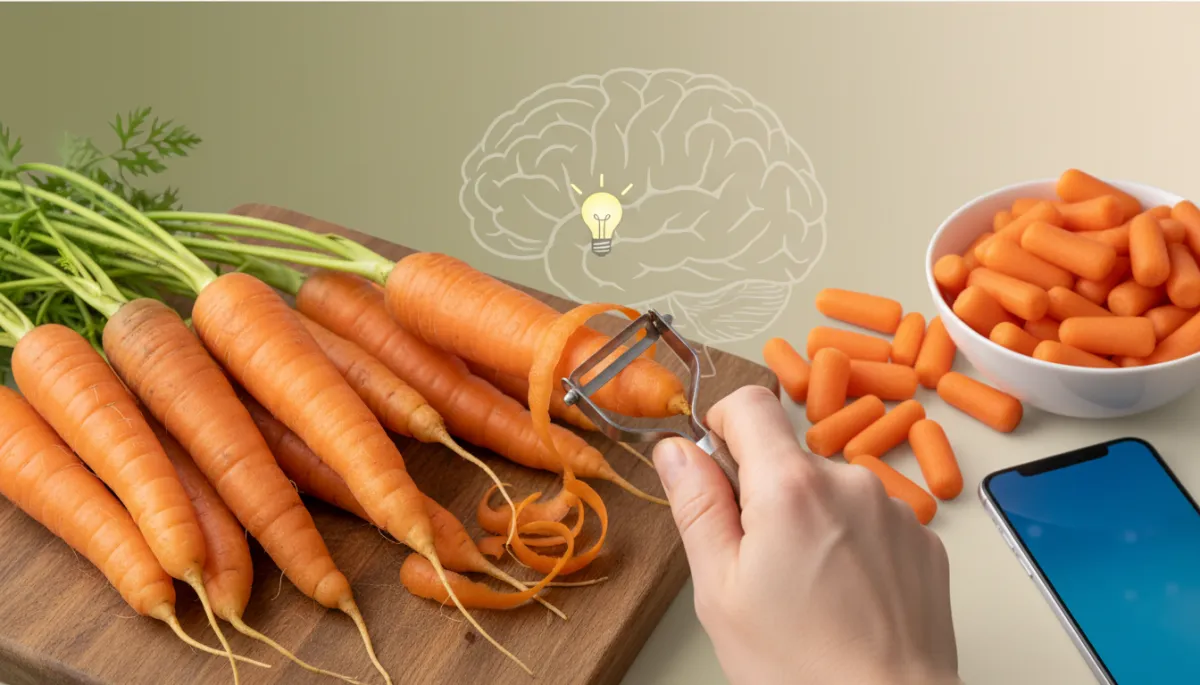
Think about baby carrots for a moment. They are smooth, uniform, glossy little cylinders, trimmed and tumbled into submission. They come in a plastic bag, washed, polished, and ready to eat. No dirt, no peeling, no odd shapes, no time required. They promise convenience, cleanliness, and speed. They fit perfectly into our grab-and-go, always-on lifestyles.
Now picture a real carrot. Uneven, maybe a little crooked, with a stubborn bit of earth still clinging to its sides. It needs rinsing. It needs peeling. It asks you to pause, to hold it in your hands, to notice its weight and its smell. It takes a few minutes of your attention before it becomes part of your meal. In return, it offers a deeper sense of connection to what you are about to put in your body, and by extension, how you are choosing to live your life.
The difference between baby carrots and real carrots is not just culinary. It is philosophical. It is about how we relate to effort, time, and ourselves. One is the symbol of our busy, shortcut-driven culture. The other is an invitation to slow down and reconnect with the simple, grounding rituals that nourish us far beyond the plate.
Busy, Toxic Lifestyles: The Hidden Cost of Shortcuts
Most of us are living on baby-carrot mode. We want everything trimmed, packaged, and ready to consume: our food, our entertainment, even our relationships and personal growth. We are conditioned to believe that faster is better, that saving time is always the smartest move, and that convenience is the highest form of progress. But what if those shortcuts are quietly eroding the very things that make life meaningful and healthy?
Our calendars are overflowing, yet our energy is depleted. We scroll endlessly, but feel strangely disconnected. We grab whatever is easiest to eat, then wonder why our bodies feel sluggish and inflamed. We multitask through meals, conversations, even rest. This is not just “being busy.” It is a toxic lifestyle disguised as productivity and success. And like a bag of baby carrots, it looks harmless—until you look more closely at what is missing.
💡 Pro Tip: Whenever you catch yourself reaching for the quickest option, pause and ask, “What is the real cost of this shortcut to my body, mind, and relationships?”
Shortcuts can be helpful in moderation, but our culture has turned them into a way of life. We shortcut sleep with caffeine. We shortcut connection with emojis and quick likes. We shortcut meals with ultra-processed snacks. We shortcut self-reflection with constant noise and distraction. Over time, these micro-shortcuts add up to macro-consequences: burnout, anxiety, chronic illness, and a haunting sense that we are missing our own lives, even as we rush through them.
What Carrots Teach Us About Health and Quality of Life
On the surface, baby carrots and whole carrots are both vegetables. They both come from the same root. But the journey they take to your plate is very different. Baby carrots are shaved down, reshaped, soaked, and packaged. Real carrots are pulled from the ground, rinsed, and left in their natural form until you decide how to prepare them. One has been processed for your convenience; the other invites your participation.
Our health and quality of life work in the same way. On paper, two people might look similar: same job title, same number of hours in a day, same access to food and information. But if one person lives in constant shortcut mode—skipping breakfast, eating in the car, sleeping with their phone, saying yes to everything—and the other intentionally builds small, nourishing rituals into their day, their lived experience will be worlds apart. One life is shaved down to the bare minimum of survival. The other retains its full shape, flavor, and color.

Simple kitchen rituals can quietly restore presence, balance, and a sense of enough.
Health is not only about what we eat, but how we eat. It is the difference between mindlessly crunching baby carrots while answering emails and consciously peeling, slicing, and enjoying a real carrot at a table, even for five minutes. That small act of presence sends a powerful message to your nervous system: you are safe enough to slow down. You are worthy of nourishment that is not rushed or fragmented. You are allowed to be here, now, with your food and your thoughts and your breath.
Peeling Real Carrots: A Tiny Act with a Big Message
That afternoon in the kitchen, as the peels fell into a little orange pile, I realized that peeling real carrots is more than a cooking task. It is a symbol. It is a declaration that you are willing to invest a few minutes of your life in something that will nourish you deeply, even if nobody sees it or applauds it. It is a quiet rebellion against the narrative that you must always be efficient, optimized, and “on.”
When you pick up a whole carrot, you are saying:
“I have time to care for myself.” Even if it is just three minutes, you are choosing to spend them in a way that honors your body.
“I am part of this process.” You are not outsourcing every step of your nourishment to a factory or a machine. You are participating in the transformation of raw ingredients into a meal.
“I am willing to slow down.” You accept that good things sometimes take a little time, and that not every moment must be maximized for output.
This is why something as simple as peeling carrots can feel strangely therapeutic. The repetitive motion, the sound of the peeler against the skin, the subtle scent rising as the carrot is revealed—it anchors you in your senses. It brings you back to your body, to your kitchen, to your actual life, instead of the endless to-do list in your head. It is a miniature mindfulness practice disguised as meal prep.
The Broader Societal Cost of Choosing Convenience Over Quality
Our obsession with convenience does not only affect our kitchens. It shapes our entire society. We choose fast news over thoughtful journalism, quick opinions over nuanced conversations, algorithm-curated feeds over genuine community. We want one-click solutions to complex problems: health in a pill, success in a hack, happiness in a purchase. We are living in a culture of baby-carrot thinking—smooth, uniform, easy to digest, but stripped of depth and texture.
This has real consequences. When we prioritize speed and ease above all else, we often:
Undervalue the people whose work takes time—farmers, teachers, caregivers, artists, healers—because their contributions do not fit neatly into short-term metrics.
Normalize burnout as the price of ambition, instead of questioning the systems that demand constant productivity at the expense of human well-being.
Accept lower-quality food, relationships, and experiences because we are too exhausted to ask for, or create, something better.
Convenience is not inherently bad. It has freed many people from backbreaking labor and opened up time for learning, creativity, and rest. But when convenience becomes our default, unquestioned setting, we lose sight of the trade-offs. We forget that every shortcut has a shadow: environmental impact, loss of skills, erosion of attention, and a gradual disconnection from the sources of our food, our goods, and even our joy.
"The things that matter most cannot be microwaved. They must be tended, stirred, and given time."
From Being Busy to Being Alive: A Gentle but Firm Challenge
Many of us wear busyness like a badge of honor. Our calendars are proof that we are important, needed, in demand. But if you look closely, constant busyness is often a mask—covering up discomfort, avoidance, or fear of what might surface in the quiet. When every minute is filled, there is no space to ask the deeper questions: Am I actually happy? Is this sustainable? What do I truly want my life to feel like?
This is your challenge: stop being busy and start living intentionally. Not someday, not when things “calm down,” but now—inside the life you already have. You do not need to move to the countryside or quit your job to begin. You can start with the smallest, most ordinary actions, like how you handle a carrot in your kitchen tonight.
📌 Key Takeaway: Intentional living is not about doing more; it is about doing fewer things with far more presence and care.
Practical Ways to Slow Down and Reconnect (Starting with Carrots)
If the idea of slowing down feels abstract, let’s make it tangible. Here are a few simple practices that use the carrot metaphor as a starting point for deeper change in your daily life:
Buy whole vegetables at least once a week. Choose carrots, potatoes, beets, or any produce that requires washing and chopping. Treat the preparation as a mini-ritual, not a chore. Notice the colors, textures, and smells as you work.
Cook one meal without multitasking. No podcasts, no emails, no TV in the background. Just you, your ingredients, and your breath. Let the process itself be nourishing, not only the final dish.
Eat one snack sitting down, without your phone. Even if it is just a sliced carrot and some hummus, give it your full attention. Chew slowly. Taste your food. Feel what it is like to not rush through a simple moment.
Question one convenience choice each day. Before you default to the fastest route, ask, “Is this actually serving my health and quality of life, or just my schedule?” Sometimes the answer will still be yes to convenience—and that is okay. The point is to choose consciously, not automatically.
Schedule white space like an appointment. Block 15–30 minutes in your day labeled simply “be.” Use that time to breathe, journal, stretch, or just stare out the window. This is the mental equivalent of peeling a carrot: unhurried, unproductive in the traditional sense, yet deeply restorative.
When You Are Open to Change, Even Carrots Can Coach You
The most powerful teachers in life are not always the loudest or the most obvious. Sometimes they are hiding in your fridge. When you are open for change and growth, even carrots can coach you. They can remind you that:
You do not have to accept a shaved-down version of your life just because it looks neat and convenient from the outside.
The messier, more hands-on path often leads to richer flavor—in food, in relationships, in self-discovery.
Time invested in caring for yourself is never wasted; it is the foundation of everything else you hope to build.
So the next time you find yourself reaching automatically for the bag of baby carrots, pause. Ask yourself what you are really hungry for. Is it speed, or is it a sense of being grounded and present in your own life? Then, just once, choose the real carrots. Rinse them. Peel them. Slice them. Let that simple act be a quiet revolution against the culture of constant rush and shallow convenience.
You deserve more than a life of shortcuts. You deserve a life with texture, depth, and nourishment. A life where you are not just busy, but truly alive. And sometimes, the path back to that kind of living begins with something as ordinary—and as extraordinary—as a carrot on a cutting board, waiting patiently for you to slow down and really see it.
