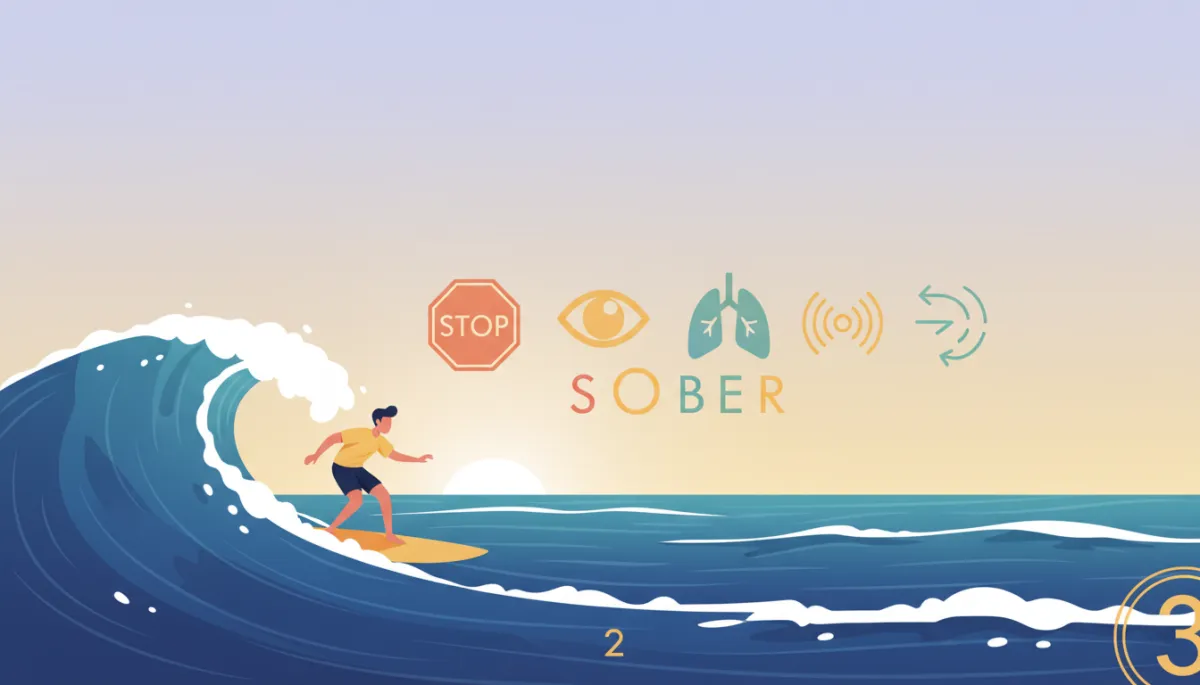
Surf the Urge: Break Bad Habits Easily
Personal Growth, Habits, Mindfulness
Surf the Urge: A Simple Way to Break Bad Habits (Part 2 of 3)
In this second part of our three-part series on transforming your habits, we dive into a surprisingly simple idea: you don’t have to fight your urges—you can learn to surf them. Drawing on the work of psychologist Dr. Alan Marlatt, you’ll discover how “urge surfing” turns bad habits, and even addictions, into waves you can ride instead of storms that knock you down.
Why Breaking Bad Habits Is Simpler Than It Feels
Most of us think breaking a bad habit requires massive willpower or a complete personality overhaul. We imagine white-knuckling our way through cravings, “being stronger,” and never slipping up again. No wonder change feels exhausting before we even start.
But there’s another way to look at it: breaking bad habits can be simple when you understand what’s really happening in your mind and body during an urge. Simple does not mean effortless or instant, but it does mean you can follow a clear, learnable process instead of relying on raw willpower alone. That’s where the idea of urge surfing comes in—a concept developed and researched by psychologist Dr. Alan Marlatt, a pioneer in addiction studies and relapse prevention.
Bad Habits as Unaddressed Addictions
We often reserve the word “addiction” for extreme cases—substance abuse, gambling, or other life-derailing behaviours. But on a smaller scale, many everyday bad habits follow the same pattern as addiction: a trigger, a craving, a behaviour, and a short-term relief that reinforces the cycle. In that sense, many bad habits are unaddressed mini-addictions to certain feelings or quick fixes:
Reaching for your phone every time you feel bored or awkward.
Snacking when you’re stressed rather than hungry.
Scrolling late into the night to avoid uncomfortable thoughts or emotions.
These habits may not be as dramatic as clinical addiction, but they are often driven by the same underlying mechanism: a powerful urge to escape or soothe a feeling. When we see bad habits this way—as unaddressed addictions to relief, comfort, or distraction—it becomes easier to understand why they feel so stubborn. You’re not “weak”; you’re simply caught in a well-practised loop that your brain has learned brings quick relief, even if it has long-term costs.
📌 Key Takeaway: Your bad habit is not a character flaw. It’s a learned response to discomfort that can be unlearned—with the right tools.
Dr. Alan Marlatt and the Birth of Urge Surfing
Dr. Alan Marlatt was a clinical psychologist whose research transformed how we understand relapse and addiction. Instead of viewing urges as enemies to be crushed, he encouraged people to observe cravings with curiosity. In his work with people recovering from substance use, he noticed something crucial: urges rise, peak, and fall—like waves. They don’t grow forever. They have a natural lifespan, especially when you don’t feed them with automatic reactions or harsh self-judgment.
From this insight, Marlatt developed the practice of urge surfing. Instead of trying to “kill” the urge, a person learns to ride it out, noticing the sensations and thoughts that come with it, without acting on them. This approach is deeply rooted in mindfulness: paying attention, on purpose, in the present moment, without judgment. Over time, people discovered that the very act of turning toward an urge with awareness robbed it of its power. The wave still rose—but it no longer had to sweep them away.
When you learn to watch an urge instead of obeying it, you reclaim your freedom of choice.
What Does It Mean to “Surf” an Urge?
Imagine a surfer paddling out into the ocean. They don’t scream at the waves to stop. They don’t try to hold the water still. Instead, they learn how waves move, how they rise and fall, and how to balance on them without being dragged under. Urge surfing works the same way. The “wave” is your craving—an intense impulse to do something: eat the cookie, send the angry text, open the app, pour the drink, light the cigarette, procrastinate on the task you care about.
To surf that wave, you don’t have to get rid of it. You simply have to stay present with it long enough for it to crest and fade. You feel it in your body, notice the stories your mind tells you (“I need this,” “Just this one time,” “I can’t handle this feeling”), and you keep breathing. The miracle is that, if you stay with it, the urge does change. It might feel intense at first, but it cannot stay at that peak forever. This is not just a comforting idea; it’s what Marlatt’s clinical work and later mindfulness-based treatments have repeatedly shown in practice.

A single mindful pause can turn an automatic habit into a conscious choice.
The SOBER Method: A Practical Map for Urge Surfing
Knowing that urges behave like waves is powerful, but you also need a step-by-step way to ride them. One accessible framework that fits beautifully with urge surfing is the SOBER method. It gives you a simple sequence to follow whenever a craving, impulse, or old habit pattern shows up: Stop, Observe, Breathe, Expand, Respond mindfully.
S – Stop
The first step is deceptively simple: Stop. This doesn’t mean “stop having the urge”; it means pause your automatic reaction. Even a 5–10 second break between urge and action can be enough to interrupt the habit loop. You might:
Put your phone down instead of unlocking it.
Close the fridge door before grabbing the snack.
Take your hands off the keyboard before sending the reactive email.
Think of this as planting your surfboard in the water. You’re saying, “I’m not going to act on this urge—yet. First, I’m going to look at it.”
O – Observe
Next, you Observe what’s happening inside you. This is where urge surfing really begins. Turn your attention toward the urge with curiosity, as if you’re a scientist studying your own experience. Ask yourself:
Where do I feel this urge in my body? (Chest, throat, stomach, hands?)
What thoughts are showing up? (“I deserve this,” “I can’t cope,” “Just one more.”)
What emotion is underneath? (Loneliness, boredom, anxiety, shame?)
The key is not to argue with what you notice, but simply to name it: “Tightness in my chest. Restlessness in my legs. Thoughts saying, ‘I need a break.’ Feeling anxious and overwhelmed.” By observing, you begin shedding light on the feelings that drive your habit, instead of letting them operate in the dark. This is how bad habits, as unaddressed addictions, start to lose their invisible grip: they become seen and understood.
B – Breathe
Now you Breathe. Take a slow, steady breath in through your nose, and a longer exhale out through your mouth. Do this a few times. Your breath is your anchor while you ride the wave. Physically, it signals your nervous system that you are safe; mentally, it gives you something simple to focus on besides the urge itself.
You can even silently say to yourself, “Breathing in, I notice this urge. Breathing out, I allow it to be here.” You are not feeding the urge with resistance or panic; you are stabilising yourself on the board as the wave moves under you.
E – Expand
With your breath steady, you now Expand your awareness. Instead of locking your attention only on the urge, you widen the lens to include your whole experience: your body, your surroundings, your values, your long-term goals. You might notice:
The feeling of your feet on the ground or your body in the chair.
The sounds in the room or outside your window.
A memory of why you wanted to change this habit in the first place—a healthier body, deeper relationships, more focus, more self-respect.
This step reminds you: you are bigger than this urge. The craving is just one part of your present-moment experience, not the whole story. As your awareness expands, you often notice that the urge is already shifting—maybe a little less intense, a little more distant. This is the heart of urge surfing: observing how urges dissipate when faced with mindfulness.
R – Respond Mindfully
Finally, you Respond mindfully. After stopping, observing, breathing, and expanding your awareness, you are now in a far better position to choose your next step. Instead of reacting on autopilot, you can ask:
What action would honour my long-term wellbeing right now?
If I imagine myself tomorrow, what choice would I be proud I made?
Responding mindfully might mean:
Choosing not to act on the urge at all—and watching it fade.
Replacing the habit with a healthier behaviour (a short walk, a glass of water, journaling, a quick stretch, sending a kind message to someone).
If you do slip into the old habit, responding with self-compassion instead of shame, and gently recommitting to your intention next time.
💡 Pro Tip: The win isn’t “never feeling an urge again.” The win is noticing the urge and still having the freedom to choose your response.
Identifying Your Triggers: Where the Waves Begin
Urges don’t appear out of nowhere. They’re usually triggered by specific situations, thoughts, or feelings. If bad habits are unaddressed addictions to relief or distraction, then triggers are the moments when that need for relief gets activated. Common triggers include:
Emotional states: stress, loneliness, boredom, anger, sadness, anxiety, even excitement.
Times of day: late at night, right after work, mid-afternoon slumps.
Environments: your couch, your desk, your car, your kitchen, certain social settings.
People or relationships: specific friends, family members, or colleagues who are linked to certain habits.
To practice urge surfing effectively, it helps to know where your waves tend to form. This week, consider keeping a simple “trigger log.” Each time you notice yourself reaching for your habit, pause afterward and jot down:
What was I doing just before the urge hit?
What was I feeling emotionally?
What thoughts were running through my mind?
Over a few days, patterns will start to emerge. Those patterns are not signs that you’re broken; they are maps showing you where your inner work lives. And they give you a clear invitation: “Here is where I can practice the SOBER method and learn to surf.”
How Urges Dissipate When Met with Mindfulness
One of the most empowering discoveries you can make is this: an urge is not permanent. It feels urgent—hence the name—but it is not endless. When you face it with mindfulness, you can watch it change in real time. Here’s what that often looks like:
The urge appears suddenly, with a spike of intensity. You feel pulled toward the habit.
You Stop and Observe—naming the sensations, thoughts, and emotions that come with it.
You Breathe and Expand—feeling your body, the room, your values, your breath.
The urge may rise a bit more, then plateau. You stay with it like a surfer balancing on a wave.
After a minute or two (sometimes longer, sometimes shorter), you notice a softening: the sensations shift, the thoughts lose some of their convincing power, the emotional heat cools a little.
This is the moment when you see, in your own direct experience, what Marlatt’s work has shown for decades: urges crest and fall. They don’t need you to fix them or fight them. They need you to witness them. And the more you practice, the more your brain learns: “I can feel this and still be okay. I don’t have to act it out.”
📌 Key Takeaway: Mindfulness doesn’t erase urges; it changes your relationship with them—from “command” to “passing weather.”
Your Practice for This Week: Surfing Your Own Urges
Personal growth becomes real when it moves from ideas to lived experience. This week, you’re invited to practice surfing your urges using the SOBER method. You don’t need to overhaul your entire life. Start small, and be specific. Here’s a simple way to begin:
1. Choose One Habit to Work With
Pick a single habit that matters to you, but feels manageable. For example:
Late-night snacking when you’re not truly hungry.
Checking social media whenever you feel bored or uncomfortable.
Procrastinating by opening a streaming app instead of starting a task.
2. Identify Your Common Triggers
For the next few days, pay attention to when this habit shows up. Use the trigger questions from earlier. You might discover, for example, that your urge to snack hits hardest when you sit on the couch after a stressful workday, or that you reach for your phone whenever you feel a hint of awkwardness in social situations. These triggers are your practice grounds.
3. When the Urge Hits, Use SOBER in Real Time
The next time you notice the urge arising, walk yourself through the SOBER steps:
Stop – Pause your hand, your phone, your movement. Give yourself a micro-break.
Observe – Notice where the urge lives in your body, what thoughts are present, and what emotions are underneath. Name them gently.
Breathe – Take several slow, deep breaths. Feel your chest rise and fall. Use your breath as your surfboard.
Expand – Widen your awareness to include your whole body, the room, your long-term goals, and the part of you that truly wants to grow.
Respond mindfully – Choose your next action from a place of clarity, not compulsion. Even if you still do the habit, notice that you did it with awareness. That alone is progress.
4. Reflect Without Judgment
At the end of each day this week, take a few minutes to reflect:
When did I surf an urge successfully? What helped?
When did I get swept away? What can I learn from that moment, gently and honestly?
Remember: this is not a pass/fail test. You’re learning a skill. Surfers fall off their boards countless times before they find their balance. Each time you notice an urge—even if you act on it afterward—you are strengthening the part of you that can wake up in the middle of the habit loop. That awareness is the foundation of real, lasting change.
Bringing It All Together: Simple, Not Easy—But Deeply Worth It
Breaking bad habits often feels mysterious and overwhelming, but at its core, the process can be simple. You learn to recognise that many of your habits are unaddressed addictions to comfort, distraction, or relief. You understand, through the work of Dr. Alan Marlatt and others, that urges are waves that rise and fall. And you practice a straightforward method—SOBER: Stop, Observe, Breathe, Expand, Respond mindfully—to surf those waves instead of being swept away by them.
This week, as you identify your triggers and practice surfing your urges, you will likely notice something subtle yet profound: you are not your habits. You are the awareness that sees them, the surfer who can choose how to ride each wave. Some days you’ll glide; other days you’ll wipe out. Both are part of learning. What matters is that you keep returning to the board, keep returning to your breath, and keep returning to your intention to grow.
In Part 3 of this series, we’ll build on this foundation by exploring how to design environments and routines that support your new, healthier habits—so that surfing the urge becomes not just a rescue skill, but a natural part of how you live every day. For now, your invitation is simple: notice the next wave, climb on your board, and surf.
Practice Prompt: Over the next seven days, pick one recurring urge and commit to using the SOBER method with it at least once a day. Watch how, with mindfulness, each wave eventually breaks and rolls back into the sea.
