
Understanding Moods: It's Not About You
Emotional Health, Boundaries, Personal Growth
People Are Allowed To Have Moods — And They’re Not About You
There is a quiet kind of freedom in realizing this: people are allowed to have moods, and those moods have absolutely nothing to do with you. Your partner’s silence, your colleague’s sharp tone, the stranger’s impatience in line — none of it is a report card on your worth. Your peace is sacred, and you are not responsible for the emotional weather of the world.
Why We Take On Other People’s Moods
If you’ve ever walked into a room, felt the tension, and instantly tightened your shoulders, you’re not alone. Many of us are emotional “sponges,” absorbing the tone of a space or the mood of a person without even realizing it. There are several reasons this happens:
Wiring for connection: Humans are wired for belonging. Our nervous systems are designed to pick up on cues of safety or threat in others. When someone is upset, our body often reacts as if something is wrong with us or between us, even when it isn’t.
Old conditioning: If you grew up around unpredictable moods — a parent who was volatile, withdrawn, or critical — you may have learned to scan other people constantly, trying to manage their emotional state to stay safe. That hyper-awareness can follow you into adulthood.
People-pleasing patterns: When we believe our job is to keep everyone happy, any sign of discomfort in someone else can feel like failure. We rush in to fix, soothe, or over-explain, hoping to restore harmony — often at the expense of our own energy.
Lack of boundaries: Without clear emotional boundaries, we blur the line between what belongs to us and what belongs to someone else. Their stress becomes “our” stress. Their anger becomes “our” problem. We start living as if we are responsible for every emotional ripple around us.
None of this means you are broken or too sensitive. It means your nervous system has been trained to over-function for others. The invitation now is to retrain it — to remember that you are allowed to be aware of others’ moods without becoming them. You can care without carrying.
The Importance of Setting Emotional Boundaries
Emotional boundaries are the invisible lines that separate your inner world from someone else’s. They protect your energy, your clarity, and your sense of self. Without them, you end up living in reaction to other people’s moods, constantly adjusting yourself to avoid conflict or discomfort.
Healthy boundaries do not make you cold or uncaring. They actually allow you to be more compassionate, because you are not overwhelmed or resentful. When you know, deep in your body, “This feeling is theirs, not mine,” you can stay grounded while they move through whatever they need to move through. You can listen without losing yourself.
📌 Key Takeaway: Boundaries are not walls to keep people out; they are doors that let you decide what comes in and what stays outside your inner space.
Remember: people are allowed to have moods. That is their right as human beings with complex inner lives. Your right is to decide how much of that emotional weather enters your own sky. You can stand beside someone in a storm without letting the rain soak your bones.
Your Peace Is Sacred: Claiming Emotional Sovereignty
Emotional sovereignty means you are the primary authority over your inner world. Your peace is not up for negotiation every time someone else has a bad day. It doesn’t mean you never feel shaken or triggered; it means you recognize that your inner state is yours to tend, and theirs is theirs to tend.
Your peace is sacred. It is not selfish to protect it; it is responsible. When you guard your peace, you show up more clearly for your work, your relationships, and your own dreams. You stop giving away your power to every passing mood, comment, or facial expression. Instead of being pulled into every emotional current, you become the steady riverbed through which your life flows.
“You are not responsible for the emotional weather of the world.”
— A reminder to your nervous system
When you really let that land, something softens. You realize you can step out of the role of emotional manager and back into the role of conscious creator of your own life. You can stop asking, “How is everyone else feeling?” before you ask, “How am I feeling?”
Practical Step 1: Pause Before You Personalize
One of the fastest ways we lose our peace is by making someone else’s mood mean something about us. Your partner walks in quiet, and your mind jumps to, “What did I do wrong?” A coworker sends a short email, and suddenly you’re convinced they’re angry with you. This automatic personalization fuels anxiety, overthinking, and self-blame.
The antidote is a conscious pause. Before you decide what their mood means, stop and create a tiny bit of space. In that space, you can choose a different story. Try this simple sequence:
Notice the trigger. “I see that my chest just tightened when they sighed.”
Name the story. “I’m telling myself this means I did something wrong.”
Offer an alternative. “There are many reasons they could be quiet — none of them about me.”
💡 Pro Tip: When in doubt, say to yourself, “Their mood is information, not a verdict.” This gentle phrase interrupts the reflex to take everything personally.
Pausing before personalizing does not mean you ignore real issues. It simply means you don’t let your mind run ahead of reality. If something actually needs to be addressed, you can do so from a grounded place: “You seem a bit off today. Is everything okay?” That’s leadership — not panic.
Practical Step 2: Observe Without Absorbing
Observing without absorbing is the art of staying present with what is happening while keeping your center intact. Imagine yourself as a calm witness: you notice the tension in the room, the edge in someone’s voice, the sadness in their eyes — and you allow it to be there without making it your job to fix or feel it for them.
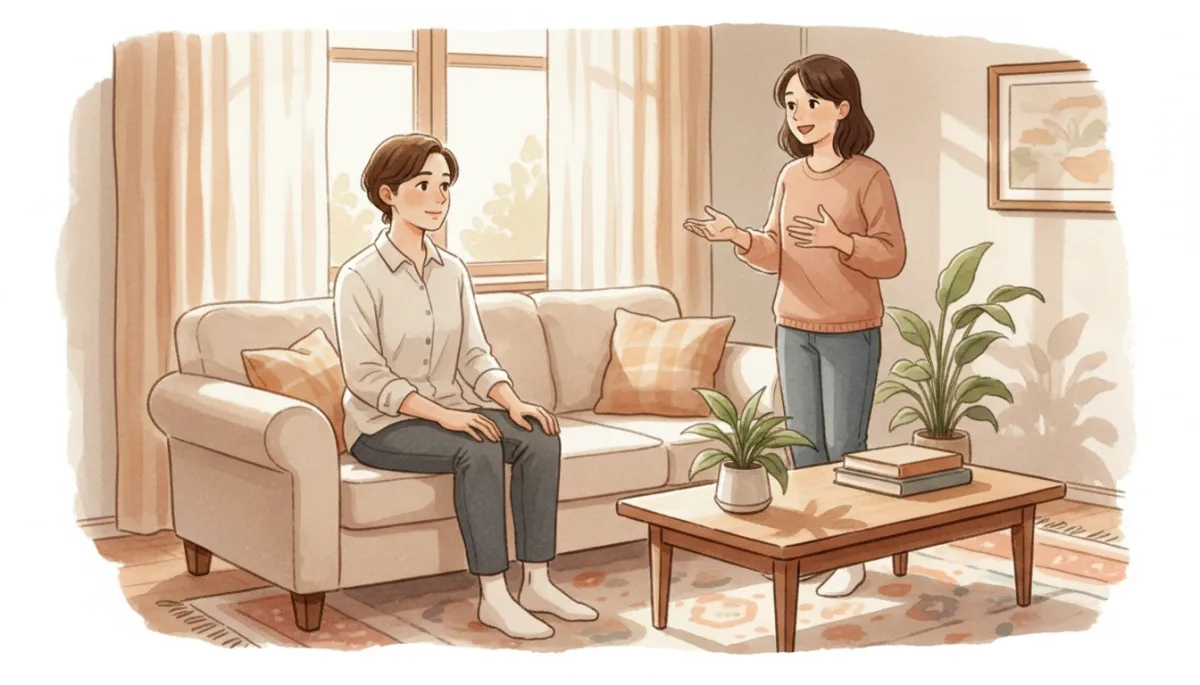
-toned photograph of a person sitting upright in a quiet living room, eyes soft and attentive,...
Holding your center lets you support others without sacrificing your own emotional stability.
You might imagine an invisible, permeable bubble around you — not to shut people out, but to remind yourself that you have an energetic boundary. Their words can enter your awareness, but they do not have to pierce your nervous system. Their frustration can be heard, without becoming your stress. Their sadness can be honored, without becoming your burden.
Silently repeat: “This is their experience. I can witness without taking it on.”
Keep a small part of your attention on your breath, feeling your inhale and exhale as an anchor.
Notice if your body starts to clench or lean forward to “fix,” and gently soften back into your own space.
Observing without absorbing is not detachment in the cold sense; it is compassionate clarity. It says, “I see you. I care. And I will not abandon myself in the process of caring for you.”
Practical Step 3: Stay in Your Body
When someone else’s mood spikes, many of us leave our bodies without realizing it. We shoot up into our heads, analyzing, predicting, worrying. Or we collapse inward, shrinking our posture, holding our breath. The fastest way back to your peace is to come back to your body — to literally inhabit yourself again.
Try these simple grounding practices in real time:
Feel your feet. Press them gently into the floor. Notice the texture of your shoes, the support beneath you. Remind yourself, “I am here. I am safe in my body.”
Relax your jaw and shoulders. These areas often tense up first. With each exhale, invite a bit more softness. This sends a signal to your nervous system that you do not need to brace.
Lengthen your exhale. Inhale gently through your nose, then exhale a little longer than you inhaled. Longer exhales activate the body’s relaxation response and help you stay present.
💡 Pro Tip: When you feel pulled into someone’s mood, silently say, “Back to my body.” Let that phrase be your cue to ground, breathe, and return to yourself.
Staying in your body is a powerful act of emotional sovereignty. It keeps you from being swept away by other people’s storms. It reminds you that you have a home base — your own nervous system — and that you can choose to remain there, even when the world around you is noisy or intense.
Practical Step 4: Lead With Your Energy, Not Their Mood
Most of us unconsciously mirror the emotional tone we walk into. If a room is anxious, we become anxious. If a person is irritated, we become defensive or small. Leading with your energy means reversing that pattern. Instead of matching the room, you bring your own grounded, intentional presence to it — and let that be the influence.
Before entering a conversation or space that tends to be emotionally charged, take a moment to choose your energy:
Ask yourself, “How do I want to feel in this interaction?” Calm? Clear? Kind? Confident?
Visualize yourself carrying that energy like a quiet light in your chest. Let it soften your face, your posture, your tone of voice.
Throughout the interaction, keep returning to that chosen state, especially if someone else’s mood spikes. “Even though they are tense, I choose to stay steady.”
This is not about performing positivity or suppressing your authentic feelings. It is about recognizing that you are a powerful energetic presence. You can be the calm in the room, the grounded one at the table, the person whose steadiness helps others regulate — without taking responsibility for whether they do or not.
📌 Key Takeaway: Leading with your energy is leadership in its purest form. You are no longer led by other people’s moods; you are led by your own intention.
Detaching From Others’ Moods as an Act of Consciousness and Leadership
Detachment often gets misunderstood as indifference, but conscious detachment is something very different. It is the ability to hold space for someone else’s experience without collapsing into it. It is the awareness that “This is happening around me or near me, but it is not happening inside me unless I invite it in.”
When you detach from others’ moods in this way, you are practicing a high level of consciousness. You are no longer a reflexive responder to emotional chaos; you are an aware participant who chooses what to engage with and how. This is leadership — in your family, your workplace, your friendships, and your own inner life.
You model what it looks like to stay calm when others are reactive.
You show that it is possible to care deeply without self-erasure.
You invite others, silently, to take responsibility for their own emotional state — just as you are doing for yours.
Detaching from others’ moods does not mean you never apologize, never reflect, or never adjust. It means you do those things from clarity, not from guilt or fear. You can say, “I’m sorry that landed badly; that wasn’t my intention,” without taking on their entire emotional experience as your fault or your job to fix.
You Are Not Responsible for the Emotional Weather of the World
Imagine waking up each day believing you had to control the sun, the wind, and the rain — that if it stormed, it was because you failed; if the sky was clear, it was because you succeeded. The pressure would be unbearable. Yet this is how many of us move through life emotionally, feeling responsible for everyone else’s inner climate.
Here is the truth: you are not responsible for the emotional weather of the world. You do not control who wakes up tired, who is triggered by their own past, who is stressed by their own choices. You are responsible for your words, your actions, your impact — but not for the entire emotional landscape around you.
💡 Pro Tip: When you feel yourself slipping into “emotional weather control,” gently repeat, “I can be an umbrella, but I am not the sky.”
Letting go of this imagined responsibility is not abandonment; it is alignment. It allows each person to own their experience and their healing. It frees you to show up as a steady, caring presence — not as an exhausted weather worker trying to manage storms you did not create and cannot prevent.
Reclaiming Your Energy and Living Intentionally
Every time you choose not to absorb someone else’s mood, you reclaim a piece of your energy. Every time you pause before personalizing, stay in your body, observe without absorbing, and lead with your own energy, you are quietly rewriting the script of your life. You move from being emotionally reactive to being intentionally responsive.
You have more bandwidth for your own goals, creativity, and rest.
Your relationships become cleaner, built on mutual respect rather than silent emotional labor.
You feel less drained at the end of the day, because you are no longer carrying feelings that were never yours.
Living intentionally in this way is not a one-time decision; it is a daily practice. Some days you will catch yourself absorbing, personalizing, over-functioning — and that’s okay. Awareness itself is progress. Each time you notice, you have a new opportunity to choose differently, to return to the truth that your peace is sacred and your energy is yours to direct.
A Simple Daily Practice to Protect Your Peace
To integrate these ideas into your everyday life, consider a short, daily ritual — just a few minutes to anchor yourself before you step into the world’s emotional weather.
Morning check-in: Before you look at your phone or open your inbox, place a hand on your heart and ask, “How am I feeling today?” Name your own mood before you encounter anyone else’s.
Set an intention: Choose one word for how you want to move through the day — “steady,” “gentle,” “clear,” “joyful.” Let this word guide how you respond to other people’s energy.
Evening release: At night, take a moment to mentally hand back any feelings that are not yours. You might say, “I return to myself. Anything that is not mine, I release.” Breathe out the day and come home to your own quiet center.
Over time, these small practices add up. You begin to trust yourself more. You feel less tossed around by other people’s moods and more anchored in your own inner life. You start to live from the inside out, instead of the outside in.
Stepping Forward as the Leader of Your Inner World
Ultimately, understanding that people are allowed to have moods — and that those moods are not about you — is a profound act of self-leadership. It asks you to step out of old roles: fixer, pleaser, emotional shock absorber. It invites you into a new role: guardian of your peace, leader of your energy, conscious creator of your life.
As you move through your day, you will still encounter impatience, stress, sadness, and frustration in others. That is part of being human together. But now you carry a different understanding:
You can pause before you personalize.
You can observe without absorbing.
You can stay in your body and lead with your own energy.
You remember, again and again, that your peace is sacred. You remember that detaching from others’ moods is not coldness; it is consciousness and leadership. You remember that you are not responsible for the emotional weather of the world — only for how you choose to walk through it.
May you reclaim your energy, gently and firmly. May you live more intentionally, anchored in your own truth. And the next time someone’s mood shifts in front of you, may a quiet voice inside remind you: This is theirs. I can stay with myself.
