Transform Your Life: Habits Over Potential
Self-Improvement, Habits, Personal Growth
Your Potential Doesn’t Change Your Life — Your Habits Do
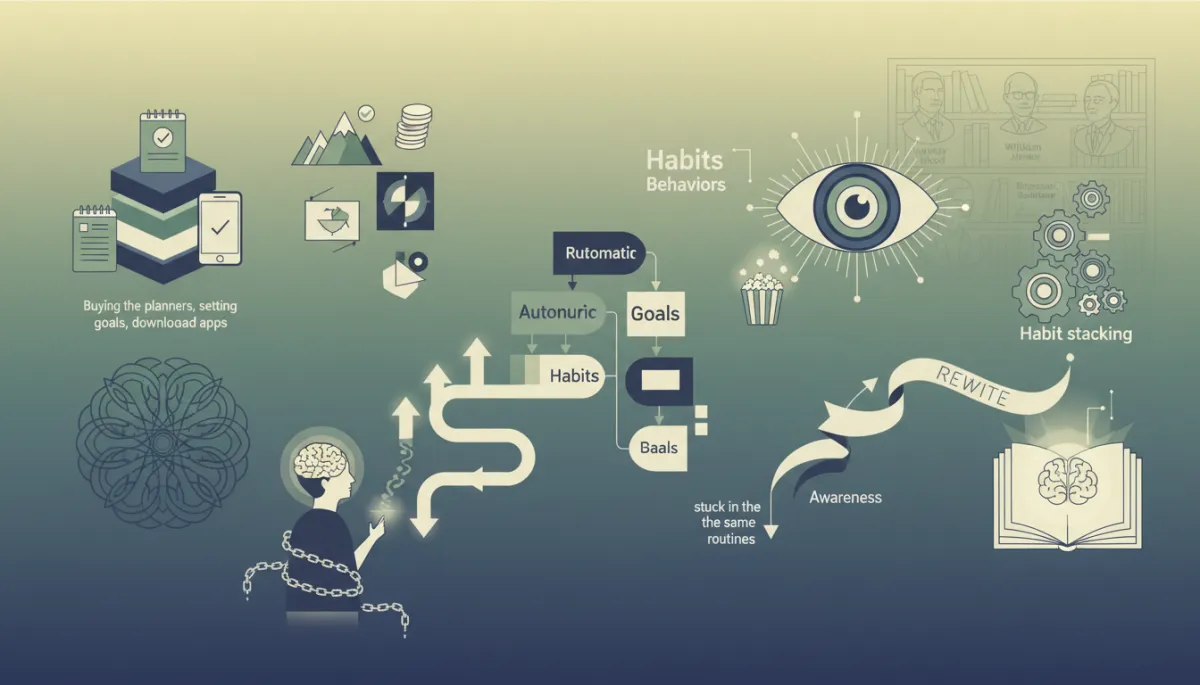
How many times have you told yourself this will be the year you finally change? You picture the healthier body, the thriving career, the deeper relationships, the financial security. You buy the planners, set the goals, download the apps, and promise yourself that this time will be different. Yet within weeks, you find yourself slipping back into the same routines that quietly run your days. The uncomfortable truth is this: habits do not care about your potential. They care about what you repeatedly do, automatically, when no one is watching and motivation has faded.
Why Potential Alone Never Delivers Results
Most people dramatically overestimate the power of potential and underestimate the power of habits. Potential is possibility. It is everything you could be, do, or create. It feels inspiring, expansive, and exciting. But potential, by itself, is passive. It does not send the emails, make the sales calls, lace up your running shoes, or open the book instead of the social media app. Only behavior does that — and most of your behavior runs on autopilot, guided by habits you rarely think about.
The psychologist William James, often called the father of American psychology, recognized this over a century ago. He wrote that a huge portion of our daily life “runs in grooves” — automatic patterns that free our minds but also lock in our results. In modern terms, your life is mostly a reflection of your habits, not your hopes. If your daily actions are misaligned with your aspirations, your potential becomes a source of frustration rather than fulfillment.
What Habits Really Are: Automatic Behaviors Running Your Life
In simple terms, a habit is an automatic behavior triggered by a cue and followed by a reward. You feel stressed, you open your favorite app. You walk into the kitchen, you reach for a snack. You sit at your desk, you check email before doing meaningful work. Over time, these behaviors become so ingrained that they occur with little to no conscious decision-making. You are not choosing them; they are choosing you.
Research by social psychologist Wendy Wood has shown just how powerful this automaticity is. In her studies, people underestimated how much of their day was habitual. When carefully measured, roughly 40–50% of daily actions were found to be habits — repeated in the same context, often with minimal awareness. That means almost half of your life is driven by routines you are barely noticing. Your potential is irrelevant in those moments; your habits are in charge.
📌 Key Takeaway: If you do not consciously design your habits, your environment and past choices will design them for you — and they may not be aligned with your highest self.
The Popcorn Study: Proof That Habits Ignore Your Intentions
One of Wendy Wood’s most cited experiments — often called the popcorn study — illustrates this perfectly. Participants were invited to a movie and given free popcorn. Some received fresh, tasty popcorn; others received stale popcorn that had been kept for a week and tasted unpleasant. You would expect people to stop eating once they realized it was bad. Yet that is not what happened.
Moviegoers who rarely ate popcorn at the cinema ate very little of the stale popcorn. Their behavior was guided by taste and conscious choice. But those who habitually ate popcorn at the movies kept eating large amounts, even when it was stale and unappetizing. Their hands moved from bucket to mouth almost automatically, driven by the context — dim lights, film playing, popcorn bucket in hand — rather than by hunger or enjoyment. Their intentions and preferences were overruled by habit.

Context can drive behavior so strongly that even bad rewards still trigger old habits.
This study delivers a sobering message: once a habit is formed, your behavior can continue even when it no longer makes sense. Logic, goals, and even negative consequences may not be enough to stop it. If you have ever found yourself scrolling on your phone long after you decided to go to bed, you have experienced this same principle. Your habits are not asking for your opinion; they are simply running their script.
How Habit Formation Really Works: Cues, Repetition, and Rewards
To change your life in a meaningful way, you must understand habit formation. Habits are not random; they are built through a consistent loop:
Cue: A trigger in your environment or internal state (time of day, location, emotion, preceding action).
Behavior: The action you take, often quickly and with little deliberation.
Reward: The outcome that satisfies a need or desire (relief, pleasure, distraction, comfort, progress).
Over time, as Benjamin Gardner and colleagues have shown in their research on habit strength, repetition in a stable context leads to increased automaticity. The brain begins to shortcut the process: when the cue appears, it jumps straight to the behavior, anticipating the reward. The more often this loop is repeated, the less conscious effort is required. What started as a decision becomes a default.
💡 Pro Tip: If you want a new habit to stick, keep the cue and context consistent. Same time, same place, same preceding action — consistency builds automaticity.
James Clear and the Power of Small, Systematic Changes
Author James Clear, in his work on habits, emphasizes that “you do not rise to the level of your goals. You fall to the level of your systems.” Goals describe your potential; systems describe your habits. If your daily system is chaotic, inconsistent, or misaligned, no amount of ambition will compensate. Clear’s framework focuses on making habits obvious, attractive, easy, and satisfying — designing your environment and routines so that the behaviors you want become the path of least resistance.
This approach is especially powerful because it acknowledges a hard truth: willpower is unreliable. Motivation fluctuates; environments exert invisible pressure; stress and fatigue narrow your options. But well-designed habits, supported by thoughtful cues and rewards, continue to function even on difficult days. They become the “default settings” of your life — and those defaults, not your occasional bursts of inspiration, determine your trajectory.
Habit Stacking: Building New Routines on Existing Foundations
One practical strategy that has emerged from modern habit research and has been popularized by James Clear is habit stacking. The idea is straightforward: instead of trying to create a new habit out of nowhere, you attach it to an existing, stable habit you already perform every day. The existing habit becomes the cue for the new one, reducing the cognitive effort required to remember and initiate the behavior.
After I pour my morning coffee, I will review my top three priorities for the day.
After I brush my teeth at night, I will read two pages of a book.
After I sit down at my desk, I will spend five minutes planning my first task before opening email.
Habit stacking works because it respects how your brain actually operates. You are not relying on vague intentions; you are plugging a new behavior into an existing routine, in a specific context. Over time, the stacked behaviors fuse into a single, extended habit sequence. This is how you can gradually construct powerful morning rituals, evening wind-downs, or workday startup routines — one small stack at a time.
Awareness: The Missing Link Between Potential and Habit Change
If habits are largely automatic, how do you change them? The first step is awareness. You cannot rewrite a script you have never read. Most people try to change their lives at the level of outcomes — lose 20 pounds, earn more money, be more confident — without examining the habitual cues and behaviors that currently produce their results. They set goals while remaining blind to the automatic routines that quietly undermine those goals every day.
Awareness means deliberately observing your automatic behaviors in real time and in context. When do you reach for your phone? What do you do when you feel anxious, bored, or overwhelmed? What typically happens in the first 30 minutes after you wake up, or the last 30 minutes before bed? Instead of judging yourself, you adopt the mindset of a curious researcher. You are mapping your own popcorn study — identifying the contexts that trigger your behavior and the rewards that keep it in place.
💡 Pro Tip: For one week, keep a simple “habit log.” Note the time, context, and emotion whenever you notice yourself acting on autopilot. Patterns will emerge faster than you expect.
From Autopilot to Author: Rewriting Habits with Intention
Once awareness is in place, you can begin the process of rewriting habits. This does not mean relying on sheer willpower to stop doing something you have repeated for years. Instead, it means systematically altering the components of the habit loop — cue, behavior, reward — in ways that support the person you want to become. You move from being a passenger on the autopilot plane to being its pilot and engineer.
1. Redesign the Cues
Many unhelpful habits are sustained by powerful environmental cues — your phone on the nightstand, snacks on the counter, the TV remote on the coffee table. To weaken these habits, you do not have to become stronger than every temptation; you can simply remove or alter the cues. Charge your phone in another room. Replace visible junk food with fruit or water. Move distracting apps off your home screen. In Wendy Wood’s terms, you are restructuring the context so that the old habit script does not automatically launch.
2. Replace, Don’t Just Remove, the Behavior
Habits exist because they serve a function: comfort, escape, stimulation, connection, or progress. If you simply try to eliminate a behavior without addressing the underlying need, your brain will look for another, often equally unhelpful, way to meet that need. Instead, identify the purpose behind the habit and deliberately choose a healthier replacement behavior. For example:
Instead of scrolling when stressed, take a two-minute walk or practice slow breathing.
Instead of snacking when bored, read a page of a book or write a quick journal note.
Instead of procrastinating on a big task, commit to five minutes of focused work.
3. Redefine the Reward
For a new habit to stick, your brain must experience it as rewarding. The challenge is that many beneficial habits (exercise, deep work, saving money) offer delayed rewards, while unhelpful habits (junk food, distractions, impulse purchases) offer immediate pleasure. To counter this, you can deliberately build in small, immediate rewards for the new behavior: a checkmark on a habit tracker, a moment of satisfaction, a brief stretch, or a few minutes of a favorite activity after completing the task. Over time, as Benjamin Gardner’s work suggests, the behavior itself will begin to feel more automatic and intrinsically rewarding.
Identity: Aligning Habits with Your Highest Self
Transforming habits is not only about efficiency; it is about identity. James Clear emphasizes that the most powerful form of habit change comes when you shift from asking, “What do I want to achieve?” to “Who do I want to become?” When you see yourself as “someone who takes care of their body,” going for a walk is no longer a chore; it is a natural expression of who you are. When you see yourself as “a focused professional,” closing distracting tabs before deep work becomes obvious rather than heroic.
Every time you follow through on a habit that reflects your highest self, you cast a small vote for that identity. No single action transforms you overnight, but the accumulation of these votes gradually reshapes your self-image. This is where intentionality becomes essential. You are no longer asking your habits to magically align with your potential. You are deliberately designing habits that reflect the person you aspire to be — and then living that identity in small, consistent ways.
Practical Framework: Bringing Awareness and Intentionality into Your Day
To bring all of this together, consider a simple, professional framework you can apply immediately. It focuses on three pillars: awareness, design, and repetition.
Step 1: Awareness Audit
Choose one area of life: health, work, finances, or relationships.
For seven days, briefly log your recurring automatic behaviors in that area.
Note the context (time, place, emotion) and the perceived reward.
Step 2: Intentional Design
Identify one unhelpful habit to rewrite and one positive habit to build.
Remove or alter cues that trigger the unhelpful habit; introduce clear cues for the new habit (possibly via habit stacking).
Define a small, sustainable version of the new habit you can perform even on your worst days.
Step 3: Repetition with Reflection
Track your new habit daily for at least 30 days, focusing on consistency over intensity.
Once a week, reflect: What cues worked? Where did autopilot take over? What can you adjust?
Celebrate small wins as evidence of your evolving identity, not just isolated successes.
Living a Life Aligned with Your Highest Self
The gap between who you are and who you could be is not filled with more potential, more information, or more motivation. It is filled with daily, repeated actions — the habits you enact when no one is watching. The research of Wendy Wood, Benjamin Gardner, William James, and contemporary thinkers like James Clear all converge on a single point: your habits quietly, consistently, and powerfully shape your life.
This is not a cause for discouragement; it is an invitation to responsibility. If your current routines are not aligned with your highest self, you are not broken — you are simply running an outdated script. With awareness, intentional design, and patient repetition, you can rewrite that script. You can create environments that support your best choices, stack new habits onto existing ones, and gradually build an identity that matches the potential you have always sensed within yourself.
The next time you feel the surge of motivation to change, remember: buying a new planner or setting ambitious goals is only the beginning. The real work — and the real transformation — happens in the small, often invisible decisions you make every day. When you bring awareness to those decisions and approach your habits with intentionality, you are no longer at the mercy of autopilot. You are consciously crafting a life that reflects your values, aspirations, and highest potential.
Habits may not care about your potential, but you do. And when you care enough to design your habits deliberately, your potential stops being a distant dream and becomes a lived reality — expressed in the quiet, consistent rhythm of your days.
