
Steve Jobs: Failure Forged an Innovation Icon
Entrepreneurship, Innovation, Personal Growth
Steve Jobs: How Failure Forged an Icon of Innovation
The story of Steve Jobs is not just about sleek devices and iconic keynotes. It is, at its core, the story of an entrepreneur and inventor who stumbled, fell, and was written off more than once—yet refused to stop moving forward. His journey from adopted child to global visionary is a powerful reminder that failure is not the opposite of success, but often its most important ingredient. This is a story about perseverance, learning from setbacks, and daring to leave a legacy that outlives you—and it is an invitation to reflect on what your own legacy might be.
Beginnings: An Unlikely Entrepreneur in a Silicon Valley Garage
Steve Jobs did not arrive in the world with a silver spoon or a guaranteed path to greatness. Adopted shortly after birth, he grew up in a working-class neighborhood in what would become Silicon Valley. His father, Paul, taught him how to take apart and rebuild electronics in the family garage. Those early lessons were less about circuits and more about craftsmanship—about caring deeply for what you create, even for the parts that no one else will ever see. That mindset became a cornerstone of Jobs’ identity as both entrepreneur and inventor: build things that matter, and build them beautifully.
Jobs tried college, then dropped out. On paper, that was his first major failure. But he stayed on campus, sleeping on friends’ floors, auditing classes that interested him. One of those was a calligraphy course—an indulgence with no obvious “career value.” Years later, that seemingly impractical decision shaped the Macintosh’s revolutionary typography and helped change how we experience digital text. From the beginning, Jobs’ journey shows a pattern: he wandered, he experimented, he made choices that looked like mistakes, and then he turned those “mistakes” into breakthroughs.
Apple’s Early Rise: Vision, Risk, and Imperfect Successes
In 1976, Jobs joined forces with his friend Steve Wozniak and launched Apple Computer in that now-legendary garage. Their first products were far from the polished devices we know today. The Apple I was a bare circuit board sold to hobbyists. It was innovative, but it was also rough, limited, and far from mainstream. The Apple II improved dramatically, yet even that success was a learning ground, filled with production challenges, design compromises, and constant iteration. Every step forward was built on a series of imperfect attempts and near-misses.
Jobs’ journey as an entrepreneur was never linear. He had a gift for seeing where technology could go, but not every bet paid off. He pushed for bold ideas, often clashing with colleagues and investors. The Lisa computer, for example, was advanced but expensive and commercially disappointing. Still, its graphical user interface and mouse-based navigation laid the groundwork for the Macintosh. Jobs was already demonstrating a crucial trait: the ability to mine failures for insights, to treat each misstep as a prototype for something better.
The Fall: Being Fired from the Company He Founded
By the mid-1980s, Apple was no longer a scrappy startup. It was a growing corporation with investors, executives, and boardroom politics. Jobs, still in his early 30s, was brilliant but also demanding and sometimes volatile. Tensions escalated between him and then-CEO John Sculley. The conflict climaxed in a boardroom showdown, and Jobs lost. In a twist that would have crushed many entrepreneurs for good, Steve Jobs was fired from the very company he had built from nothing.
Imagine that for a moment: pouring your identity, your ideas, and your youth into a dream, only to be told you are no longer wanted. Jobs later described this period as devastating. He felt publicly humiliated and directionless. But he also called it one of the best things that ever happened to him. Stripped of the weight of being a corporate icon, he rediscovered what he loved most: building new things. This is where his perseverance shines through. Instead of walking away from technology entirely, he started again—this time without the safety net or the myth of invincibility.
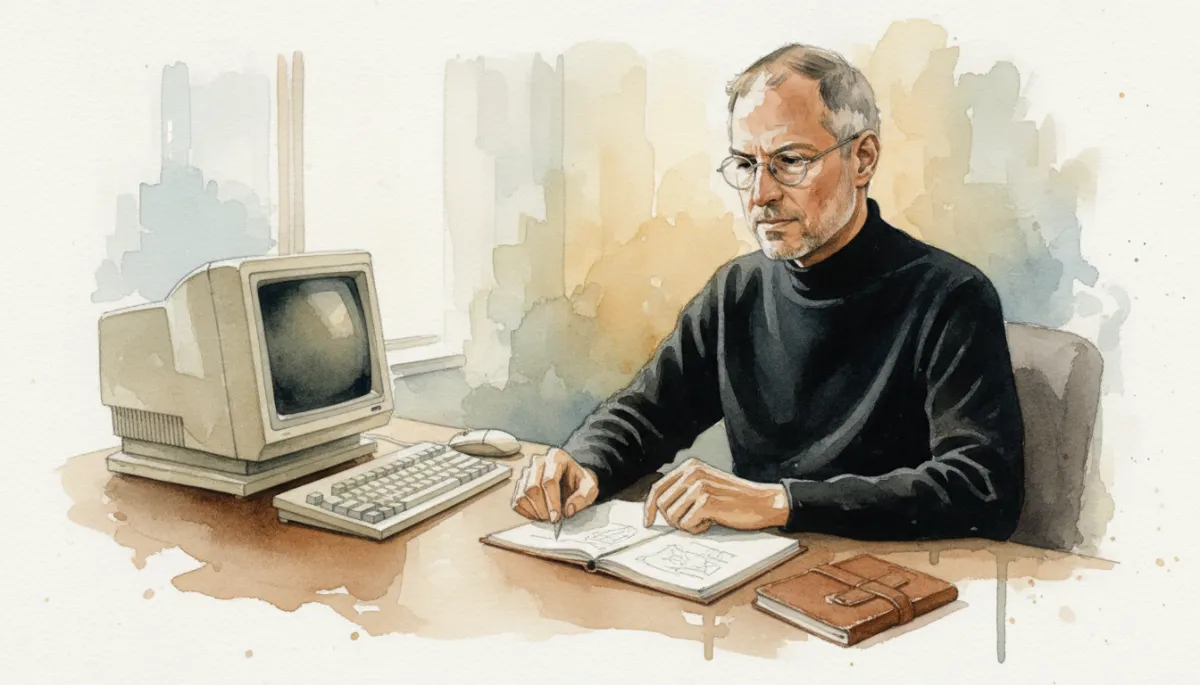
After being forced out of Apple, Jobs quietly used reflection and hard lessons to fuel his next chapter.
NeXT and Pixar: Learning in the Wilderness Years
Jobs’ response to his ousting was not to retire, but to launch two new ventures: NeXT and Pixar. NeXT, a computer company aimed at the education and business markets, never became a mainstream commercial hit. Its computers were powerful but expensive, and sales were modest. By traditional measures, NeXT might be labeled a failure. Yet the software it developed later formed the foundation of macOS and iOS. What looked like a dead-end experiment became the technical backbone of Apple’s future.
Pixar, meanwhile, was initially a hardware and animation company that struggled to find its place. For years, it lost money. Jobs poured in funding and absorbed repeated disappointments. But he stayed the course, believing that computer-animated storytelling could become something extraordinary. That belief paid off when Pixar released Toy Story, the first full-length computer-animated film. It was a triumph that reshaped an entire industry and turned Pixar into a powerhouse. Crucially, Jobs had learned to be more patient, to trust creative partners, and to balance his intensity with collaboration. His failures were no longer just bruises; they were lessons he actively applied.
Return to Apple: Reinvention Through Relentless Focus
In 1997, more than a decade after he had been pushed out, Apple was in trouble. Sales were down, products were confusing, and the company’s future looked uncertain. Apple acquired NeXT to gain access to its software, and with that acquisition came Steve Jobs. He returned first as an advisor, then as interim CEO, and finally as the permanent leader. It would have been easy for him to come back with bitterness or a desire to prove others wrong. Instead, he came back with something more powerful: clarity born of failure and time away.
Jobs slashed Apple’s sprawling product line to just a few focused offerings. He insisted on simplicity, elegance, and a laser-sharp sense of purpose. Out of this renewed focus came the iMac, a computer that was as much a design statement as a machine. It signaled a new era for Apple—one where technology, art, and user experience were inseparable. This was not the same Steve Jobs who had left years earlier. He was still demanding, still visionary, but he had learned how to channel his intensity, how to say no to distractions, and how to build teams that could execute his ideas at the highest level.
The iPod, iPhone, and iPad: Redefining Entire Industries
As an inventor and entrepreneur, Jobs is best known for the products that came next. The iPod did more than store music; it transformed how we related to songs, artists, and even our commutes. The iPhone turned the phone into a pocket-sized computer, camera, and personal assistant. The iPad reimagined what a computer could be in the living room, the classroom, and beyond. Each of these products disrupted industries, from music and telecommunications to publishing and gaming.
What’s easy to forget is that none of these devices were guaranteed successes. Internally, there were doubts, delays, prototypes that didn’t work, and features that had to be abandoned. Jobs pushed teams hard, but he also accepted that experimentation meant some ideas would fail. The iPhone, for instance, went through multiple design directions before the final version emerged. Behind every “overnight revolution” was a long, messy process of trying, failing, and trying again. Jobs’ perseverance wasn’t about blind stubbornness; it was about holding onto the larger vision while staying flexible about the path to get there.
Failure as a Teacher: How Jobs Turned Setbacks into Fuel
Across all these chapters—Apple’s early stumbles, his firing, NeXT’s struggles, Pixar’s uncertain years—one pattern stands out: Jobs’ ability to learn from failure. He did not romanticize it; he felt the pain deeply. But he refused to let it define his future. Instead, he examined what went wrong, adjusted his approach, and carried the lessons forward. When he was too controlling, he learned to empower the right people. When products were too complex, he doubled down on simplicity. When markets were not ready, he refined the story and the experience until they were.
This is where his perseverance becomes most instructive. For Jobs, pushing forward without stopping did not mean repeating the same mistakes. It meant evolving. It meant being humble enough to admit what hadn’t worked, yet bold enough to keep aiming for something extraordinary. That combination of humility and ambition is rare—and it is exactly what allowed his failures to become stepping stones instead of dead ends.
A Legacy of Innovation That Outlives the Man
When Steve Jobs passed away in 2011, the world didn’t just mourn the loss of a CEO. It mourned a creative force who had reshaped how we live, work, and connect. His legacy of innovation is visible in the devices we carry, the interfaces we use, and even the expectations we now have of technology. We expect our tools to be intuitive, beautiful, and deeply integrated into our lives—because Jobs insisted they could be.
But his legacy is not limited to products. It lives in the culture of companies that prioritize design, in entrepreneurs who dare to challenge entire industries, and in creative professionals who refuse to settle for “good enough.” Jobs showed that innovation is not just about having ideas; it is about having the courage to chase them, the discipline to refine them, and the resilience to keep going when the world doubts you. That is a legacy that anyone—regardless of field—can draw strength from.
What Steve Jobs’ Story Means for Your Own Journey
It is easy to look at Steve Jobs and see only the highlight reel: the standing ovations, the iconic black turtleneck, the product launches that changed the world. But behind every highlight was a long timeline filled with doubt, rejection, and risk. That is precisely why his story holds so much power for anyone trying to build something meaningful—whether you’re launching a business, writing a book, changing careers, or simply trying to live more intentionally.
You may not be designing the next iPhone, but you are, in a very real sense, designing your life. Along the way, you will face your own versions of being fired, of failed projects, of ideas that do not land the way you hoped. The question is not whether you will encounter setbacks. You will. The question is: what will you do with them? Will you treat them as verdicts on your worth, or as raw material for your next chapter? Jobs chose the latter, again and again. You can, too.
Reflecting on Your Potential to Leave a Lasting Legacy
Legacy is not reserved for famous founders or global icons. Your legacy is the sum of the choices you make, the work you do, and the people you influence—often in ways you may never fully see. Steve Jobs’ story invites you to ask some uncomfortable but empowering questions:
What am I building that could outlast my own lifetime—an idea, a business, a body of work, a way of leading or caring?
Where have I let past failures convince me to stop, rather than to improve and try again?
If I looked at my life as a long-term project, what bold experiment would I start today?
You do not need to know all the answers right now. Jobs certainly didn’t when he was dropping out of college or tinkering in a garage. What matters is that you stay in motion—that you keep exploring, learning, and refining your path. Your legacy will not be defined by a single moment, but by your willingness to keep showing up, especially when the story gets hard.
A Call to Action: Push Forward Without Stopping
Steve Jobs once said, “I’m convinced that about half of what separates successful entrepreneurs from the non-successful ones is pure perseverance.” That perseverance is not glamorous. It looks like late nights, difficult conversations, abandoned drafts, revised plans, and countless small decisions to keep going when it would be easier to give up. It looks like admitting when something isn’t working—and then trying a new approach instead of walking away entirely.
As you think about your own journey—as an entrepreneur, a creator, a professional, or simply a person who wants to make their time count—let Jobs’ story be more than inspiration. Let it be a mirror. Where are you holding back because you’re afraid to fail? Where have you quietly accepted a smaller life than the one you’re capable of living? And what might change if you decided, today, to push forward without stopping—to treat every setback as data, every disappointment as training, and every small win as proof that you are moving in the right direction?
You may never stand on a stage unveiling a product to the world. But you can still build something that matters. You can still choose perseverance over resignation, curiosity over comfort, and courage over fear. Steve Jobs’ life shows what can happen when someone refuses to let failure have the final word. The rest of the story—the part that belongs to you—starts with a simple, powerful decision: do not stop.
Take a moment today to reflect on the legacy you want to leave. Write it down. Name one small action you can take in the next 24 hours that moves you closer to it—a phone call, a first draft, a difficult choice, a new habit. Then take that step. And tomorrow, take another. Over time, those steps will add up to something larger than you can currently imagine. That is how legacies are built: not in a single leap, but in a thousand moments of choosing to continue.
