Stay Motivated: Achieve Your Goals with Ease
Motivation, Personal Growth, Goal Setting, Productivity
Carrot or Stick? How to Finally Get (and Stay) Motivated to Reach Your Goals
At one time or another, everyone struggles with getting and staying motivated. Imagine if every time you set a goal, you simply followed a clear path, step-by-step, until it was done—no drama, no delay, just consistent progress. While that fantasy version of ourselves sounds wonderful, real human beings are wired with resistance. We resist commitment, we resist direction, and surprisingly, we even resist doing the very things we say we want most. Understanding what truly motivates you—your personal “carrot or stick”—is the first step to breaking that pattern and finally achieving your goals with more ease and consistency.
Why Staying Motivated Is So Hard (Even When You Really Care)
If you have ever stared at a goal—a healthier body, a thriving business, a more organized home—and thought, “I really do want this… so why am I not doing anything about it?”, you are not alone. This gap between what we want and what we actually do is one of the most frustrating parts of being human. It is also completely normal. Our brains are built to conserve energy, avoid discomfort, and stay in familiar patterns. In other words, we are wired for resistance, not rapid change.
Motivation, then, is not a magical feeling that some people are born with and others are not. It is a response. Your brain responds to what it perceives as rewarding and what it perceives as threatening. When those signals are weak, distant, or unclear, you drift. When those signals are strong and immediate, you act. That is why you can spring into action when a deadline is tomorrow, but drag your feet for months on a personal goal that technically matters more to you. The pressure is different. The motivation is different. The wiring being activated is different.
Understanding your own wiring—what truly gets you moving—is the missing link for many people. Instead of blaming yourself for “laziness” or “lack of willpower,” it is far more powerful to ask a better question: What kind of motivation actually works for me? That is where the classic “carrot or stick” idea becomes incredibly useful.
Carrot vs. Stick: Two Very Different Motivation Languages
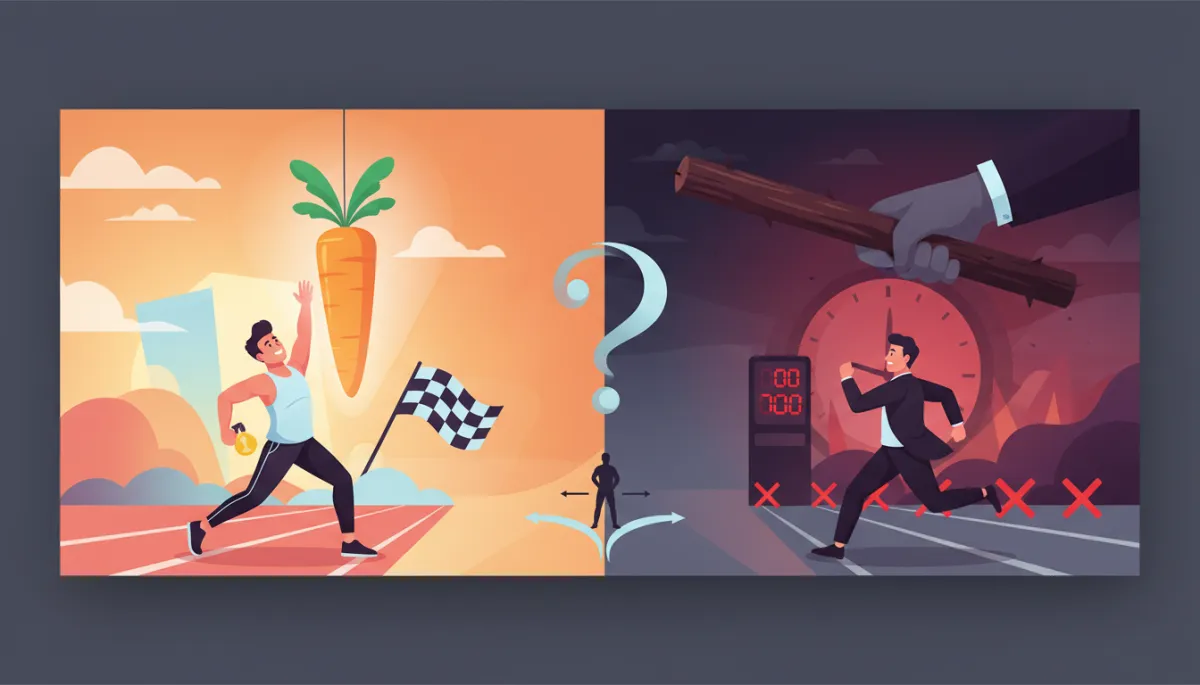
The “carrot and stick” metaphor comes from the image of a person trying to get a donkey to move—offering a carrot as a reward or using a stick as a consequence. While we have (thankfully) evolved past that kind of literal motivation, the principle still applies to how we move ourselves and others into action. Most people respond to both rewards and consequences, but usually one of them works better and more consistently than the other. That dominant style is your primary motivation language.
Are You a Carrot Person?
Carrot people are driven by rewards, games, and the thrill of winning. If you are a carrot person, you come alive when there is something fun or desirable at the finish line. Tell you there is a prize, a bonus, a celebration, or even just a gold star waiting for you, and your energy surges. You love:
Competing—with yourself or with others—to hit a target
Earning rewards, recognition, or visible proof of progress
Turning goals into challenges, games, or streaks
For carrot people, the promise of what you will gain is what pulls you forward. You are more likely to push yourself for a bonus than to avoid a reprimand. You are more inspired by “If I do this, I get to…” than by “If I do not do this, something bad will happen.” When you are not using rewards intentionally, you may find yourself unmotivated, bored, or uninterested—because nothing exciting is on the line.
Or Are You a Stick Person?
Stick people, by contrast, are fired up by consequences, accountability, and pressure. If you are a stick person, you may not love high-stress situations, but you often do your best work when the heat is on. You are motivated by what you could lose—respect, trust, money, time, or opportunity—if you do not follow through. You are especially sensitive to:
Deadlines, especially when someone else is counting on you
The fear of disappointing a boss, client, or loved one
Avoiding conflict, criticism, or negative feedback
Stick people often excel in pressure situations. You might procrastinate until the last minute, then suddenly produce impressive results when the consequences become real. Raised voices, stern words, or a serious meeting with the boss may not be your favorite experiences, but they get your attention—and they work. If the boss calls you into the office, your first thought is, “Am I in trouble?” That sensitivity, when used intentionally, can be a powerful motivator instead of just a source of stress.
Most of Us Are a Mix—But One Side Wins
The truth is, almost everyone responds to both carrots and sticks. You probably like rewards and want to avoid negative consequences. However, one of these will usually be more powerful, more consistent, and more reliable for you. That is your primary motivation strategy. When you know which one it is, you can stop guessing and start designing goals and environments that actually work with your wiring instead of against it.

When you speak the right motivation language, resistance drops and results accelerate.
A Real-World Example: When the “Stick” Finally Worked
Consider the story of a client who was generally effective and capable, but had developed a pattern of resisting certain action items. She would eventually complete them, but only after delaying, negotiating, and stretching out her timelines. On paper, she looked productive. In reality, she was dancing around her deadlines and slowing down her own results. Her coach could see that she was capable of much more, but gentle nudges and logical explanations were no longer working. Something had to change.
In one pivotal meeting, after she had once again resisted completing some fundamental tasks, the coach took a different approach. Instead of calmly reminding her of the importance of the work, the coach spoke very sternly—using an expletive to emphasize the point—and gave her a clear, non-negotiable ultimatum: time-block the action items by next week, or else. The message was blunt: “I am tired of seeing the same items on this list. Get them done.” The coach switched from carrot to stick, speaking in a language of firm consequences instead of soft encouragement.
In the moment, it was not obvious whether the message had landed. The client seemed taken aback, even a bit stunned. But the following week, she returned with every task completed exactly as required. Not only that, the shift stuck. For more than a month afterward, she continued to follow through promptly, without the old resistance and delay. Once the coach finally spoke in a motivation language she could hear, everything changed. The “stick” unlocked her best performance—not because she liked being pushed, but because consequences resonated more strongly for her than rewards or gentle reminders.
This story illustrates a crucial truth: motivation is not one-size-fits-all. What feels harsh or unnecessary to one person may be exactly what another person needs to break through their resistance. When you know whether you are primarily a carrot or stick person, you can stop waiting for the “right mood” and instead create the right structure.
How to Identify Your Personal Motivation Strategy
Knowing whether you are driven more by carrots or sticks is not about labeling yourself as “positive” or “negative.” It is about noticing what consistently gets you moving. Here are some practical ways to discover your dominant style.
1. Look at Your Past Wins
Think back to three or four goals you have actually achieved—things you are genuinely proud of. Maybe you completed a degree, hit a sales target, lost weight, launched a project, or paid off debt. For each one, ask:
What pulled me forward the most: the reward at the end or the consequences of not doing it?
Did I respond more to the promise of something good or the pressure of something bad?
If your strongest memories involve chasing prizes, promotions, praise, or personal milestones, you are likely more carrot-driven. If your memories revolve around avoiding failure, not wanting to let people down, or scrambling to meet deadlines, the stick may be your primary driver.
2. Notice How You React to Deadlines and Rewards
Pay attention to your day-to-day behavior. When someone offers a bonus or a fun incentive, do you feel a jolt of energy? Or do you shrug it off, only to spring into action when there is a hard deadline or potential consequence? Ask yourself:
Do I get more done when I am excited about a reward or when I am worried about a consequence?
Do I naturally create games and challenges for myself, or do I naturally create pressure and accountability?
3. Run the Two-Goal Experiment (Your Call to Action)
The most powerful way to identify your strategy is to test it directly. Set up two small but meaningful goals for the next 7–14 days. Make them comparable in size and effort—something like:
Goal A (Carrot): If I exercise for 20 minutes a day for 7 days, I will treat myself to a massage or a special outing.
Goal B (Stick): If I do not write for 20 minutes a day for 7 days, I will donate a set amount of money to a cause I do not personally support or give up a weekend activity I love.
Track both goals honestly. Do not weaken the reward or soften the consequence. At the end of the experiment, notice:
Which goal did you complete more consistently?
Which one felt more urgent or compelling during the week?
💡 Pro Tip: Do not judge your results. There is no “better” type. The goal is not to become a carrot person or a stick person—it is to understand which method actually gets you moving so you can use it on purpose.
How Motivation Shapes Your Ability to Achieve Goals
Motivation is not just a feeling; it is the engine behind your behavior. When the engine is weak, even simple tasks feel heavy. When the engine is strong, challenging goals become surprisingly doable. Understanding your motivation style affects your goals in several key ways:
Clarity: Turning Vague Wishes into Concrete Drivers
Many goals fail because they are vague. “Get in shape,” “grow my business,” or “be more organized” are not clear enough to move you. When you add the right motivation structure—carrot or stick—you turn a fuzzy wish into a concrete driver: “If I complete three workouts this week, I get to book that weekend trip,” or “If I do not send these proposals by Friday, I will forfeit my Saturday plans.” Suddenly, the goal is not just an idea; it has teeth. It has meaning. It has urgency.
Consistency: Moving Beyond Short Bursts of Effort
Anyone can be motivated for a day. The real challenge is staying motivated long enough to see results. When your goals are aligned with your natural motivation style, consistency becomes easier. Carrot people can create ongoing reward systems—points, levels, streaks, or escalating prizes. Stick people can set up recurring accountability—weekly check-ins, public commitments, or meaningful consequences for dropping the ball. The more consistent the structure, the less you have to rely on willpower alone.
Resilience: Getting Back on Track After Setbacks
No goal journey is perfectly smooth. There will be days when you slip, stall, or feel like giving up. When you understand how you are motivated, you can design a comeback plan. Carrot people can re-ignite their drive by refreshing the reward—adding something exciting to look forward to when they get back on track. Stick people can reset consequences or increase accountability—perhaps involving a coach, mentor, or peer who will not let them off the hook. Instead of spiraling into guilt or frustration, you simply adjust the motivation dials and keep going.
Designing an Environment That Sets You Up for Success
Motivation does not live only in your head. It also lives in your environment—the people around you, the systems you use, and the way you structure your days. To produce amazing results in your life or business, you need to be willing to set up an environment that supports your motivation style instead of sabotaging it.
For Carrot People: Build Visible Rewards and Playful Structure
If you are primarily carrot-driven, your environment should constantly show you what you are working toward. Consider:
Creating visual progress trackers—charts, jars, apps, or boards where you can see points, streaks, or milestones.
Setting clear, appealing rewards for specific milestones, not just the final goal.
Turning work into a game—timed sprints, friendly competitions, or challenges with friends or colleagues.
The more you can infuse your environment with a sense of play, progress, and reward, the more naturally you will move toward your goals. You are not being childish; you are being strategic about how your brain works.
For Stick People: Build Accountability and Real Consequences
If you are primarily stick-driven, you need structure that makes inaction uncomfortable and visible. Consider:
Scheduling regular check-ins with a coach, mentor, or peer where you must report your progress honestly.
Making public commitments—telling your team, friends, or family what you will do and by when.
Creating meaningful consequences for missed actions, such as donating to a cause you do not support, doing an extra task you dislike, or temporarily giving up a favorite leisure activity.
The goal is not to punish yourself harshly; it is to create enough pressure that your brain takes the goal seriously. When your environment reflects real consequences, your natural tendency to avoid disappointment or conflict becomes a powerful ally.
Motivating Others: Speaking Their Language, Not Yours
If you lead a team, manage employees, or even just want to support friends and family, this carrot-and-stick awareness is invaluable. Most leaders motivate others the way they like to be motivated. Carrot-driven leaders offer rewards, praise, and incentives. Stick-driven leaders emphasize deadlines, accountability, and consequences. But if your style does not match the person you are trying to motivate, your message may not land—just like the coach in the earlier story who had to switch tactics with her resistant client.
Take time to observe your team. Who lights up when you talk about bonuses, recognition, or fun incentives? Who suddenly springs into action when you clarify expectations, deadlines, and consequences? Tailoring your approach to each person is not coddling; it is smart leadership. When you speak to people in the motivation language they naturally respond to, you help them produce results faster and more consistently—without constant pushing and frustration.
Your Next Step: Test the Theory and Build Your System
Motivation is not about waiting for inspiration to strike. It is about understanding how you are wired and then designing goals, structures, and environments that make action almost inevitable. When you stop relying on vague hopes and start using carrots and sticks strategically, you move from “I wish” to “I did.”
Now it is your turn to experiment. Do not just think about whether you are a carrot or stick person—test it. Set up two separate goals: one with a reward, the other with a consequence. Make both goals clear, specific, and time-bound. Then watch yourself in action. Which goal do you achieve faster? Which one feels more urgent, more compelling, or more satisfying to complete?
When you see the results, you will have something far more valuable than a motivational quote or a burst of temporary inspiration. You will have insight—real, personal insight—into how your motivation engine works. With that insight, you can:
Design future goals with the right mix of rewards and consequences.
Create an environment—at home, at work, in your business—that supports your natural style instead of fighting it.
Motivate others more effectively by recognizing their primary drivers.
Remember: there is nothing wrong with you if you resist, procrastinate, or struggle to stay motivated. That resistance is built into how human beings operate. The difference between people who dream and people who consistently achieve is not that one group has more willpower; it is that they understand what truly motivates them and design their lives accordingly. Once you are willing to tell the truth about what actually gets you moving—whether it is the promise of a carrot or the pressure of a stick—you gain real leverage over your results.
So set up your two goals. Attach a reward to one and a consequence to the other. Watch what happens. Then, take what you learn and build a system around it—a system that makes it easier to “get ’er done,” step-by-step, until you look back and realize you have become the kind of person who does not just set goals, but actually achieves them.
