Resilience: Transform Challenges into Strength
Personal Growth, Resilience, Professional Development
Woven by Challenges: How Resilience Turns Life’s Trials into Strength
In a world of constant change, pressure, and uncertainty, resilience is no longer a “nice-to-have” trait—it is an essential professional and personal advantage. This article explores why resilience matters, how life’s challenges quietly weave it into our character, and practical strategies you can use to transform adversity into lasting growth and strength.
Why Resilience Matters in a Demanding Professional World
Resilience is the capacity to adapt, recover, and grow in the face of stress, setbacks, and uncertainty. It is not about never feeling overwhelmed or discouraged; it is about what you do next. For professionals navigating tight deadlines, shifting priorities, and personal responsibilities, resilience is the difference between burning out and breaking through.
High performers are not those who never stumble; they are the ones who learn how to stand up faster, wiser, and more focused. Tony Robbins captures this mindset when he says, “It is in your moments of decision that your destiny is shaped.” Resilience is built in those decision points—when you choose to respond rather than react, to learn rather than retreat, and to move forward even when the path is not clear.
Challenges as Threads: How Adversity Weaves Resilience into Our Being
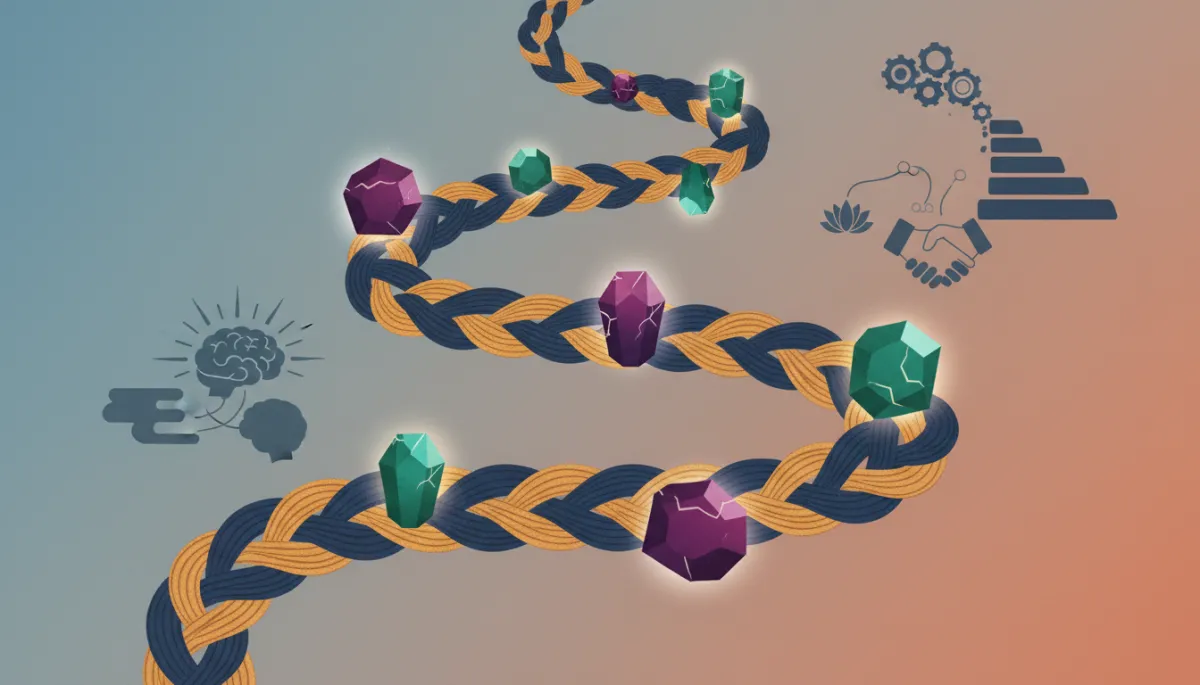
Imagine your life as a tapestry. At first glance, you see the big picture—career milestones, relationships, personal achievements. But if you look closely, you notice the individual threads: moments of doubt, failed projects, difficult feedback, personal loss, and unexpected change. These are not flaws in the design; they are the very threads that give the tapestry its texture, depth, and strength. Challenges are the threads that weave resilience into our being. Each test you face stretches you just enough to expand your capacity for courage, patience, and perspective.
Without resistance, muscles do not grow. Without tension, bridges do not hold. Likewise, without challenges, resilience remains an abstract concept rather than a lived quality. When we recognize difficulties as part of the weaving process, we stop viewing them as interruptions to our lives and start seeing them as integral to who we are becoming. This subtle shift in understanding is the foundation of every resilience strategy that follows.

Resilience is crafted thread by thread, each challenge adding strength and depth.
Strategy 1: Shifting Perspective from “Why Me?” to “What Now?”
The first strategy in building resilience is learning to shift your perspective. When a project collapses, a promotion falls through, or a personal plan unravels, it is natural to think, “Why is this happening to me?” While understandable, that question often traps you in frustration and self-pity. Resilient people ask a different question: “What now?” or “What can I learn from this?” That subtle pivot moves you from victim to active participant in your own story.
Perspective does not change the facts of a situation, but it profoundly changes how you experience those facts. For example, a demanding boss can be seen as an impossible obstacle—or as an intense, real-time leadership course in communication, boundaries, and emotional regulation. A failed product launch may feel like a career-ending disaster, or it can become the catalyst for deeper market research, better collaboration, and more innovative thinking. The event is the same; the meaning you assign to it is different. Resilience grows in that gap between what happens and how you choose to interpret it.
💡 Pro Tip: When you feel stuck in “Why me?”, write down three alternative explanations for what is happening—at least one that frames the situation as an opportunity to grow.
Strategy 2: Cultivating a Positive, Realistic Mindset
Resilience is often misunderstood as blind optimism. In reality, resilient professionals cultivate a positive but realistic mindset. They acknowledge difficulties honestly while holding onto the belief that they can influence outcomes and grow through the process. This is not about repeating empty affirmations; it is about training your mind to look for possibilities, resources, and next steps—even when circumstances are tough.
A positive mindset starts with the stories you tell yourself. Do you interpret setbacks as evidence that you are not capable, or as feedback that helps you improve? Do you dwell on what you cannot control, or do you focus on the specific actions you can take today? One practical approach is to regularly challenge catastrophic thinking. When you catch yourself thinking, “This will ruin everything,” ask, “What is the most likely outcome?” and “What small step can I take to improve this situation right now?” Over time, these micro-corrections in thinking accumulate into a more resilient mental framework.
“Keep your face to the sunshine and you cannot see a shadow.”
— Helen Keller
Helen Keller’s words are not a call to ignore hardship; they are an invitation to intentionally orient your attention toward what sustains you—your values, your strengths, your relationships, and your long-term vision. This orientation does not erase the shadows, but it ensures they do not define your entire field of view.
Strategy 3: Building a Support Network You Can Lean On
Resilience is deeply personal, but it is not meant to be built in isolation. High-pressure careers often reward self-reliance, yet the most resilient professionals understand the power of connection. A strong support network—colleagues, mentors, friends, family, or professional coaches—acts as a stabilizing framework when life feels uncertain. These are the people who remind you of your strengths when you forget, help you see options when you feel cornered, and offer practical assistance when your capacity is stretched thin.
Building such a network requires intentionality. It means investing in relationships before you desperately need them—offering help, sharing knowledge, and being willing to be vulnerable about your own challenges. In the workplace, this may look like cultivating peer alliances, joining cross-functional projects, or seeking out mentors who have navigated similar obstacles. Outside of work, it might involve reconnecting with old friends, joining professional associations, or engaging in community groups that share your interests or values.
📌 Key Takeaway: Resilience is not a solo performance. It is a shared rhythm, strengthened every time you give and receive support.
Strategy 4: Practicing Self-Care and Self-Compassion
You cannot be resilient if you are constantly running on empty. Self-care is not indulgence; it is infrastructure. It includes the habits, routines, and boundaries that protect your physical energy, emotional balance, and mental clarity. Adequate sleep, movement, nutrition, and time away from screens are not luxuries reserved for less busy people—they are prerequisites for sustainable performance and clear thinking in high-stakes environments.
Alongside self-care sits self-compassion, which is equally critical yet often overlooked. Many professionals are far harsher on themselves than they would ever be on a colleague or friend. When you make a mistake, do you berate yourself, or do you respond with the same understanding you would extend to someone you respect? Self-compassion does not mean lowering your standards; it means recognizing that imperfection is part of being human and that growth rarely follows a straight line. Treating yourself with kindness in difficult moments reduces shame, stabilizes your emotions, and creates the psychological safety required to learn from experience rather than hide from it.
💡 Pro Tip: When you catch your inner critic taking over, pause and ask, “If a trusted colleague were in this situation, what would I say to them?” Then offer those same words to yourself.
Strategy 5: Embracing Failure as a Stepping Stone to Success
Perhaps the most powerful shift in building resilience is redefining your relationship with failure. In many professional cultures, failure is treated as something to avoid at all costs, a permanent stain on your reputation. Yet every meaningful innovation, career leap, or personal reinvention is built on a foundation of attempts that did not go as planned. Thomas Edison famously reframed his countless experiments with the light bulb by saying, “I have not failed. I’ve just found 10,000 ways that won’t work.” This perspective is not just clever; it is profoundly resilient.
When you embrace failure as data rather than a verdict on your worth, you free yourself to take calculated risks, to iterate, and to pursue ambitious goals. Instead of asking, “What if I fail?” you begin to ask, “What will I learn if I try?” Each setback then becomes a stepping stone—a source of insight that informs your next move, sharpens your judgment, and deepens your resilience. Over time, this mindset turns what once felt like dead ends into detours that still move you toward your larger vision.
“Success is the result of good judgment; good judgment is the result of experience; experience is often the result of bad judgment.”
— Common saying often echoed in leadership circles
This cycle captures why resilient professionals do not fear missteps. They understand that today’s imperfect attempt is tomorrow’s refined expertise, provided they are willing to reflect, adjust, and try again.
The Ongoing Journey: Transforming Adversity into Growth and Strength
Resilience is not a destination you arrive at once and for all; it is a journey you travel repeatedly, every time life diverges from your plan. The process often follows a recognizable arc. First comes disruption: a sudden change, a loss, an unexpected obstacle. Then comes disorientation: confusion, frustration, or self-doubt. But with awareness and practice, this is followed by reflection: asking what this experience is here to teach you, what values it is clarifying, and what strengths it is calling forward. Finally, you reach integration: you adjust your approach, update your beliefs, and move forward with a deeper sense of who you are and what you can handle.
Tony Robbins often emphasizes that “Life is happening for you, not to you.” While this can be challenging to accept in the midst of genuine hardship, it offers a powerful lens. Seeing adversity as something that can serve your growth does not minimize the pain or difficulty involved. Instead, it honors your agency—the fact that you can choose how to respond, what meaning to create, and who you become as a result. Over time, you begin to recognize patterns: the times you found courage you did not know you had, the skills you developed under pressure, the relationships that deepened because of shared struggle. These realizations reinforce your belief that you can handle future challenges, creating a self-strengthening cycle of resilience.
📌 Key Takeaway: Resilience is not about avoiding adversity; it is about transforming it into a source of wisdom, confidence, and inner strength.
Putting It All Together: Your Personal Resilience Blueprint
To make these ideas practical, consider creating your own resilience blueprint—a simple, personalized plan you can return to when life feels overwhelming. Start by reflecting on past challenges you have already survived. What inner resources did you draw on? Who supported you? What did you learn about yourself? This reflection reminds you that resilience is not something you are starting from scratch; it is something you are strengthening.
Perspective: Write down a grounding question you will ask yourself in difficult moments, such as “What now?” or “What might this be here to teach me?”
Mindset: Identify three beliefs you want to cultivate—for example, “I can learn from any situation,” “Setbacks are temporary,” or “My effort matters even when results are uncertain.”
Support Network: List the people you can reach out to for perspective, encouragement, or practical help. Commit to nurturing those relationships regularly, not just in crisis.
Self-Care and Self-Compassion: Choose two or three non-negotiable habits that keep you grounded—perhaps a short daily walk, a consistent bedtime, or a weekly check-in with yourself to acknowledge your efforts and feelings.
Failure Reframing: Decide in advance how you will interpret setbacks. You might adopt Edison’s mindset and commit to asking, “What did this attempt teach me?” after every disappointment.
This blueprint is not a rigid checklist; it is a living document that evolves as you do. The more you use it, the more natural resilience becomes—less of an abstract ideal and more of a practiced, embodied way of moving through life.
Closing Thoughts: Stronger, Not Unscarred
Resilience does not promise a life free from difficulty. It does not mean you will never feel fear, grief, or uncertainty. Instead, it offers something more realistic and ultimately more empowering: the ability to remain grounded in who you are, even when circumstances shake the ground beneath you. It allows you to move through life’s inevitable challenges with greater clarity, courage, and compassion—for yourself and for others walking their own difficult paths.
The tapestry of your life will not be defined by the absence of hardship, but by the way those hard moments are woven into a story of growth and strength. With each challenge you face, you are adding new threads—of perspective, mindset, connection, care, and courage. Over time, those threads form a resilient fabric that can hold far more than you once believed possible. You may not choose every challenge, but you can always choose how you respond, and in that choice lies the power to transform adversity into the very strength that carries you forward.
