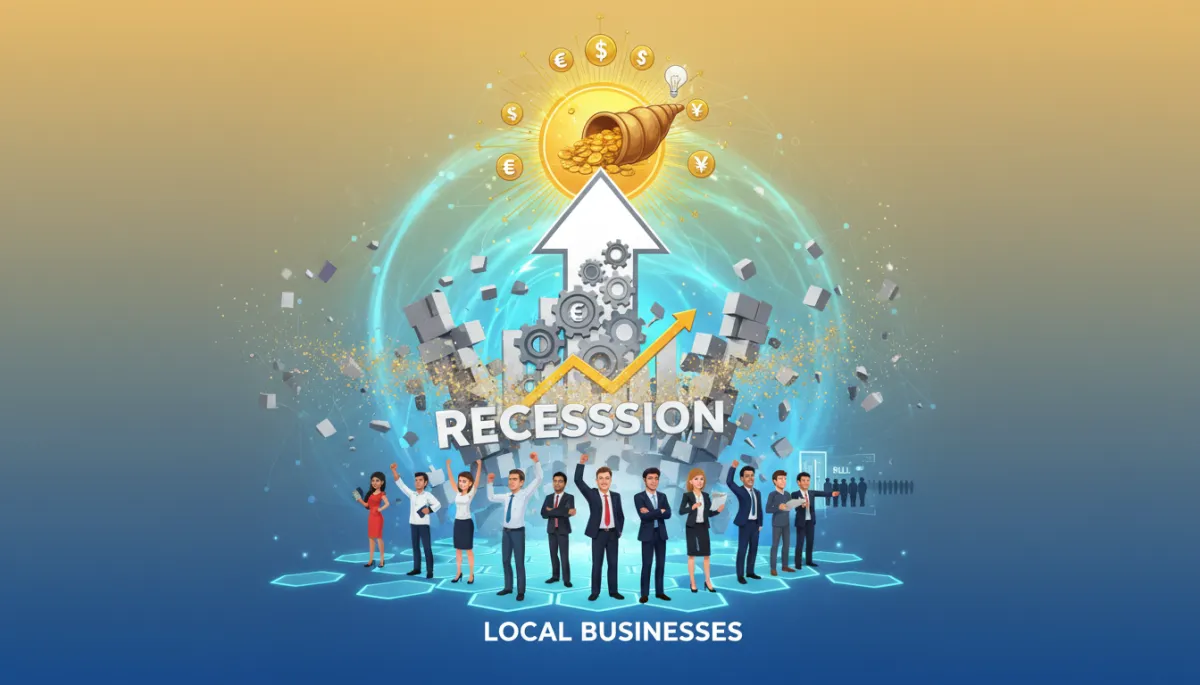
Recession Myths: Growth for Local Businesses
Local Business, Growth, Mindset
Why “Recessions Are Bullshit” for Businesses That Refuse the Herd Mentality
If you own a local business, you’ve probably heard it a thousand times: “People aren’t spending, it’s a recession,” “Everyone’s tightening their belts,” “Now’s not the time to grow.” Let’s be blunt: recessions are bullshit for business owners who refuse to think like the herd. The economy might slow down on paper, but opportunity doesn’t disappear. It simply shifts hands—from fearful, passive owners to those who are willing to think differently, talk bigger, and move faster.
“Recessions Are Bullshit” — When You Stop Thinking Like Everyone Else
On the news, a recession is a story. For the herd, it becomes an excuse. For serious local business owners, it’s a filter. It separates those who wait for permission from those who decide, “I’m going to grow anyway.” The idea that a recession automatically means your business must shrink is a mental trap. The numbers may dip nationally, but your business is not the national average. Your business is a living system driven by attitude, conversation, innovation, and opportunity-seeking.
Look around in any downturn: some restaurants have empty tables, while others have waiting lists. Some gyms are closing, while others are expanding to a second location. The difference is rarely “the economy.” The difference is the owner’s beliefs and behavior. Those who buy into the recession narrative pull back on marketing, stop hiring, lower their standards, and start apologizing for their prices. Those who call bullshit on the story do the exact opposite: they lean in, get louder, and take market share while everyone else is hiding.
Growth Exists for Owners Who Refuse the Herd Mentality
Herd mentality is deadly for local businesses. When the crowd panics, they all do the same four things:
Cut marketing first, hoping to “save money”
Discount prices, training customers to expect cheap instead of value
Freeze hiring and reduce service quality to “get by”
Stop talking about growth and start talking about survival
Meanwhile, the owner who refuses the herd mentality sees an opening. When everyone else goes silent, your voice becomes louder by default. When competitors disappear from people’s feeds, inboxes, and conversations, your message stands out. When they stop investing in their customer experience, you become the obvious choice. Growth is not only possible; it’s often easier because you’re competing with fewer serious players.
📌 Key Takeaway: A recession doesn’t remove opportunity; it removes distracted competitors. The space they leave behind is yours to claim.
How to Take Advantage of the Clueless Herd
If most local businesses around you are reacting emotionally to headlines, they’re not thinking strategically. That makes them easy to outmaneuver. Here’s how you can take advantage of the clueless herd without being ruthless—just by being smarter and braver:
Show up where they’ve disappeared. If they’ve cut ads, double down on targeted local campaigns. If they’ve stopped posting, post consistently and with purpose. Visibility alone can shift entire streams of customers your way.
Raise your standards while they lower theirs. When others cut staff and service, you improve your training, tighten your systems, and deliver a sharper customer experience. People always pay for certainty and care, especially in uncertain times.
Acquire customers they’re neglecting. Reach out to your competitors’ former customers with irresistible offers, better guarantees, and clearer communication. When the herd stops calling, you start calling.
You’re not exploiting people; you’re serving them better than the businesses that abandoned them. The herd chooses fear. You choose responsibility and growth. That’s the edge.

While competitors pulled back, this owner doubled down on service and visibility.
From Linear to Exponential: Creating Runaway Growth in Any Market
Most local businesses think in straight lines: “If I get ten more customers this month, that’s good enough.” Exponential growth comes when you stop thinking in ones and start thinking in multipliers. Even in a so‑called recession, you can build compounding growth by stacking small, smart moves that feed each other:
Turn every happy customer into three referrals with a simple, direct ask and a clear reward.
Capture every visitor’s contact details and follow up relentlessly with offers, stories, and invitations to return.
Build partnerships with complementary local businesses so that every promotion reaches multiple audiences at once.
Do this month after month and you don’t just “survive the recession.” You outgrow your current capacity. You start to see what exponential feels like: more calls than you can answer, more bookings than you can schedule, and more word‑of‑mouth than you can track. That’s when you encounter a new “problem”—you have to turn away demand because your business is overwhelmed by success.
Turning Away Demand: The “Too Busy” Problem You Actually Want
Imagine this: your phone rings nonstop, your inbox is stacked with inquiries, and your booking calendar is slammed for weeks. Customers are asking to be put on a waiting list. You’re not chasing anyone; they’re chasing you. This is not a fantasy. It’s the natural outcome of being the one local business that refused to shrink when everyone else did.
When you reach the point where you’re turning away demand, you gain leverage. You can:
Raise prices without guilt because your value is obvious and your slots are limited
Choose only the best‑fit clients and customers, improving your daily experience
Expand to a second location, new product line, or premium tier with confidence
That level of demand doesn’t care whether the news says “recession” or “boom.” It responds to how you show up, how you innovate, and how relentlessly you talk about the future you’re building.
The Foundation: Attitude Is Your First Competitive Advantage
Before strategy, before marketing, before any tactic—your attitude sets the ceiling for your business. If you see yourself as a victim of the economy, you will act like one. If you decide that you’re the creator of your own market, you will hunt for opportunities that others never see. The same neighborhood, the same customers, the same conditions—yet completely different results because the owner’s inner game is different.
Attitude is not fluffy. It shows up in concrete ways:
How you respond when a big client cancels or a slow week hits—do you spiral, or do you ask, “Where’s the opportunity in this?”
Whether you walk into your shop like a tired caretaker or like a leader on a mission to grow.
Whether you talk about problems more than possibilities—or the other way around.
💡 Pro Tip: Make a personal rule: you will not complain about “the economy” unless you’ve had at least ten proactive growth conversations that week.
Conversation: Your Most Underrated Growth Tool
Local business is built on conversation. Not just ads, not just posts—real, human conversations about what you do, what you’re building, and who you serve. In a so‑called recession, most people’s conversations shrink: “It’s tough out there,” “No one’s spending,” “We’re just trying to hang on.” If you repeat that story, you’re programming your own brain and your customers’ expectations to match it.
Flip it. Start talking about:
The new services you’re launching and why they’re exciting
The growth targets you’re aiming for this quarter and this year
The type of customers you want more of and how you help them win
Talk this way to your team, your suppliers, your customers, your friends, and your community. Conversation is marketing. Every time you speak about your goals and dreams, you’re planting seeds in people’s minds. Someone you spoke to last month remembers you when their neighbor needs exactly what you offer. Someone you met at a networking event mentions your name in a group chat. That’s how opportunity quietly compounds.
Innovation in Marketing: Out‑Think, Don’t Out‑Spend
You don’t need a massive budget to grow during a recession narrative. You need innovative marketing—creative ways to reach people, tell your story, and make offers that feel irresistible. While the herd is slashing their ad spend and running generic “10% off” deals, you can stand out by thinking deeper:
Host small, high‑value events in your space: tastings, workshops, behind‑the‑scenes tours, VIP preview nights. Turn your location into a stage for connection.
Create “recession‑defying” bundles that solve bigger problems, not just cheaper versions of what you already sell. People will spend more for solutions that feel smart and complete.
Tell customer success stories everywhere: on your walls, in your emails, on your social channels, in your conversations. Make it obvious that people win when they work with you.
Innovation in marketing doesn’t mean chasing every new platform. It means asking, “How can I communicate our value more clearly, more boldly, and more often than anyone else in town?” When you do that, the recession narrative loses its grip. People stop thinking about “cutting back” and start thinking, “I’d be crazy not to work with them.”
Seek Opportunity Like It’s Your Full‑Time Job
In every market—good or bad—there are pockets of demand that are underserved, ignored, or mishandled. The business owners who grow are the ones who actively hunt for those pockets. Seeking opportunity is not something you do once a year in a planning meeting. It’s a daily habit:
Ask customers what they wish existed that they can’t find locally.
Watch for businesses closing or pulling back—what customers are they abandoning, and how can you serve them better?
Look at trends in your industry nationally and ask, “How can I bring a version of that to my neighborhood first?”
When you train yourself to see opportunity everywhere, the idea of recession starts to feel ridiculous. The world is full of problems, desires, and gaps in service. As a local business owner, your job is to step into those gaps. That’s where growth lives—especially when the herd has convinced itself nothing is possible.
Speak Your Goals and Dreams Relentlessly
One of the most powerful things you can do—especially in a climate obsessed with bad news—is to speak about your goals and dreams relentlessly. Not in a vague, “someday” way, but in a specific, committed way:
“We’re going to double our membership this year.”
“We’re opening a second location on the other side of town.”
“We’re becoming the most talked‑about [your niche] in this city.”
Say it to your team. Say it to your customers. Say it to your network. The more you speak it, the more your brain starts searching for ways to make it real, and the more other people start looking for ways to help you. Ambition is contagious. In a “recession,” when most people are whispering about cutting back, your boldness feels electric. People remember the business owner who talks like the future is bright—and they want to be part of that story.
Refuse to Be Sucked into the Recession Narrative
The recession narrative is loud, repetitive, and seductive. It offers you something dangerous: permission to play small. It tells you that it’s reasonable to stop trying, to stop dreaming, to stop pushing. If you accept that story, you will live inside it. Your job as a local business owner is to reject that script completely.
You don’t have to deny reality. You simply choose a different one:
Where others see a downturn, you see discounted rent, available staff, and cheaper advertising.
Where others see “no one is buying,” you see “buyers are more selective, so I’ll be the obvious best choice.”
Where others retreat, you advance—carefully, intelligently, but boldly.
Refusing the recession narrative doesn’t mean ignoring data; it means refusing to let fear write your business plan. You choose to let attitude, conversation, innovation, and relentless opportunity‑seeking drive your decisions instead.
Your Local Business, Your Rules: Create Your Own Economy
At the end of the day, “recessions are bullshit” is not a denial of economic cycles. It’s a refusal to hand over your power to a headline. Your local business operates in a real community, serving real people, solving real problems. That reality is far more important than any talking head on TV. When you stop thinking like the herd and start acting like a creator, you build your own micro‑economy—one where:
Growth is normal, even when others are shrinking.
Demand is abundant enough that you sometimes have to turn people away.
Your biggest challenge is not survival, but choosing which opportunities to pursue first.
That is available to you, right now, regardless of what anyone says about “the economy.” It starts with a decision: I will not think like the herd. I will not shrink to fit their fear. I will grow. From there, every conversation, every marketing move, every innovative idea, and every opportunity you chase becomes a brick in the new reality you’re building.
So the next time someone tells you, “Well, you know, with the recession…” smile and let them talk. Then get back to doing what real local business leaders do: creating so much value, so much demand, and so much momentum that you’re too busy growing to participate in their panic.
