Lessons from 'Married at First Sight' for Entrepreneurs
Entrepreneurship, Personal Growth, Relationships
I’m Going to Tell You Something That Might Ruin My Credibility: I Love Married at First Sight
And it’s not just because of the drama. It’s because this wild social experiment is one of the clearest mirrors I’ve ever seen for entrepreneurship, transformation, leadership, relationships, weight loss, and building the life you actually desire. If you’re willing to look closely, every episode is a masterclass in hope, fear, self-sabotage, and what it really takes to grow.
The Beginning: Hope, Possibility, and Believing in Something Bigger
Every season of Married at First Sight begins the same way: nervous singles putting on outfits, writing vows to a stranger, and walking toward an altar where they’re about to marry someone they’ve never met. It is outrageous. It is questionable. And it is also incredibly human. Underneath the TV lights and editing, you see something universal: the beginning of a big decision, powered by hope and a willingness to believe in something bigger than your current reality.
That moment at the altar is what day one of any big transformation looks like. It’s the same energy as:
Signing the paperwork to start your business
Swiping your card for a high-ticket coaching program or mastermind
Stepping on the scale and saying, “This time, I’m really changing my life”
Saying “yes” to leading a team, even though you’re terrified you’re not ready
At the beginning, hope is loud. Possibility feels bigger than fear. You’re willing to believe that experts matched you perfectly, that your business idea is the one, that this coach, this program, this plan will finally unlock the version of you that you secretly know is in there. That willingness to believe in something bigger is not naive. It’s necessary. No meaningful transformation starts without it.
How Married at First Sight Mirrors Entrepreneurship and Transformation
When you watch the couples on Married at First Sight, you’re not just watching love stories; you’re watching change in real time. And change, whether it’s in business, leadership, relationships, or your body, follows similar patterns. The show is essentially a compressed, high-pressure incubator of the same dynamics that show up when you try to build the life you desire.
Entrepreneurship: Your Business Is Your Spouse
Starting a business has a lot in common with marrying a stranger. You sign contracts, make vows (to yourself, your clients, your vision), and suddenly you’re in a relationship with something you don’t fully understand yet. On the show, couples quickly realize that the fantasy of marriage is very different from the reality of sharing a bathroom, a bank account, and a bed with another human being. In entrepreneurship, the fantasy of “freedom” and “being your own boss” collides with invoices, failed launches, awkward sales calls, and days where nothing works the way you thought it would.
Both marriage and entrepreneurship expose your patterns. If you avoid conflict, you’ll avoid hard conversations with your spouse and with your team. If you chase validation, you’ll do it in your relationship and in your marketing. If you shut down when you feel rejected, you’ll pull away from your partner and stop showing up online. Your business, like a spouse, will constantly reflect back who you are being, not just what you are doing.
Transformation, Leadership, and Relationships: The Same Emotional Muscles
Whether you’re leading a team, trying to lose weight, or building deeper relationships, you are working with the same emotional muscles: vulnerability, courage, patience, and self-honesty. On the show, you see people who have never truly been seen or heard try to lead themselves through a brand-new relationship in front of millions of viewers. That’s leadership in its rawest form—taking responsibility for your reactions, your triggers, and your growth, even when you feel wildly unprepared.
Leadership isn’t just about managing others; it’s about being willing to go first. The person who says, “This is uncomfortable, but I’m willing to talk about it” is leading. The entrepreneur who says, “This launch failed, but I’m willing to look at why” is leading. The partner who says, “I’m scared you’ll leave, and I want to work through that instead of shutting down” is leading. The person who says, “I’ve gained weight, and instead of hiding, I’m going to recommit to myself” is leading. It’s all the same skill set, just in different arenas.
Weight Loss and Personal Growth: The Body as Another Relationship
Weight loss and body transformation are often treated like a separate category, but they’re not. They’re another form of relationship—this time, with your own body. On Married at First Sight, you see how people talk about themselves, how they feel about being seen, how they react when they don’t feel attractive or adequate. Those same beliefs show up in the dressing room, at the gym, and on the scale. The body keeps the score, not just of what you eat, but of what you believe about yourself.
When someone on the show says, “I’m not used to someone choosing me,” that’s not just about romance. That’s a statement about self-worth, and it touches everything: whether you invest in your health, whether you think you’re allowed to take up space in a room, whether you believe you deserve to feel strong, energized, and alive. Personal growth is the thread that runs through all of it. You can’t create a thriving business, a healthy relationship, or a sustainable weight loss journey from a place of deep self-rejection. You might get short-term results, but they won’t last.

Honest reflection on your patterns is the starting point of any real change.
The Moment Everyone Pulls Back: Discomfort, Rejection, and Fear
If you watch enough seasons, you start to recognize a familiar turning point on Married at First Sight. The wedding glow fades. The honeymoon ends. Real life starts. Someone says something careless. Someone doesn’t feel chemistry. Someone feels rejected, unseen, or misunderstood. And then it happens: they pull back. They stop trying. They get sarcastic. They shut down or blow up. They protect themselves instead of staying open to the process they signed up for.
That exact moment happens in entrepreneurship too. You launch your offer and get crickets. You post content and lose followers. A client asks for a refund. A mentor gives you honest feedback you don’t want to hear. Suddenly, all your old stories rush in:
“Maybe I’m not cut out for this.”
“People don’t want what I have to offer.”
“I should wait until I’m more ready, more qualified, more perfect.”
In weight loss, it’s the first time you “mess up” your plan and decide the whole thing is ruined. In relationships, it’s the first big conflict where you wonder if you chose the wrong person. In leadership, it’s the first time your team doesn’t respond the way you hoped. The temptation in all of these moments is to retreat—to go back to what’s familiar, even if it wasn’t working. This is the crossroads: do you lean in, or do you pull away?
Entrepreneurship Exposes Your Patterns and Demands Emotional Resilience
One of the reasons entrepreneurship can feel so brutal is that it doesn’t just ask for your skills; it asks for your nervous system. Your business will constantly bump into your deepest patterns: your fear of being seen, your urge to please, your avoidance of conflict, your relationship with money, your ability to tolerate uncertainty. It is not just a career path; it is an emotional bootcamp that never really ends.
On Married at First Sight, you watch people say, “I always pick the wrong person,” or “I shut down when I feel hurt,” or “I run when things get hard.” The show doesn’t create those patterns; it simply makes them impossible to ignore. Entrepreneurship does the same. It hands you a mirror and says, “Here is how you respond to fear. Here is how you handle rejection. Here is how you behave when you don’t get what you want right away.”
Emotional resilience isn’t about never feeling those things; it’s about building the capacity to stay. To stay with the discomfort of a slow month. To stay with the awkwardness of a sales call. To stay with the vulnerability of putting out an offer that might not sell. To stay with the sting of a partner’s feedback instead of retaliating or retreating. That ability to stay present and keep moving—even when your nervous system is screaming for escape—is what separates people who build the life they desire from people who keep circling the same patterns for years.
The Importance of Leaning Into Discomfort (Instead of Interpreting It as a Sign to Stop)
Discomfort is not a sign you’re on the wrong path. Often, it’s a sign you’re right on schedule. On the show, the couples who grow the most are rarely the ones who feel instant fireworks and zero conflict. They’re the ones who say, “This is hard, and I’m willing to sit in the hard with you.” They don’t run from awkward conversations. They don’t avoid talking about money, sex, values, or fears. They lean in, again and again, even when every part of them wants to bolt.
The same is true for entrepreneurship, weight loss, and personal growth. The moment it gets uncomfortable is often the moment the real work begins. That’s when you’re not just following a plan; you’re confronting yourself. Leaning into discomfort might look like:
Posting the offer even though you feel “salesy”
Going to the gym even after a binge instead of punishing yourself with more avoidance
Admitting to your partner, “I’m scared and I’m tempted to shut down right now”
Having the hard conversation with your team member instead of hoping it fixes itself
Discomfort is the tuition you pay for the life you desire. You don’t get to build a thriving business, a strong body, and a deep relationship while staying emotionally comfortable all the time. That doesn’t mean you have to white-knuckle your way through everything; it means you learn to distinguish between danger and growth. Most of the time, what feels like danger is actually just growth in disguise.
The Myth of the Fearless Entrepreneur (and the Reality of Messy Action)
There’s a persistent myth that successful entrepreneurs are fearless—that they’re wired differently, that they don’t care what people think, that they’re naturally confident and bold. Watch any season of Married at First Sight and you’ll see how untrue that is in the realm of relationships. The bravest participants are not the ones who never feel fear; they’re the ones who feel fear and still walk down the aisle, still have the hard conversations, still stay open to love when they have every reason to shut down.
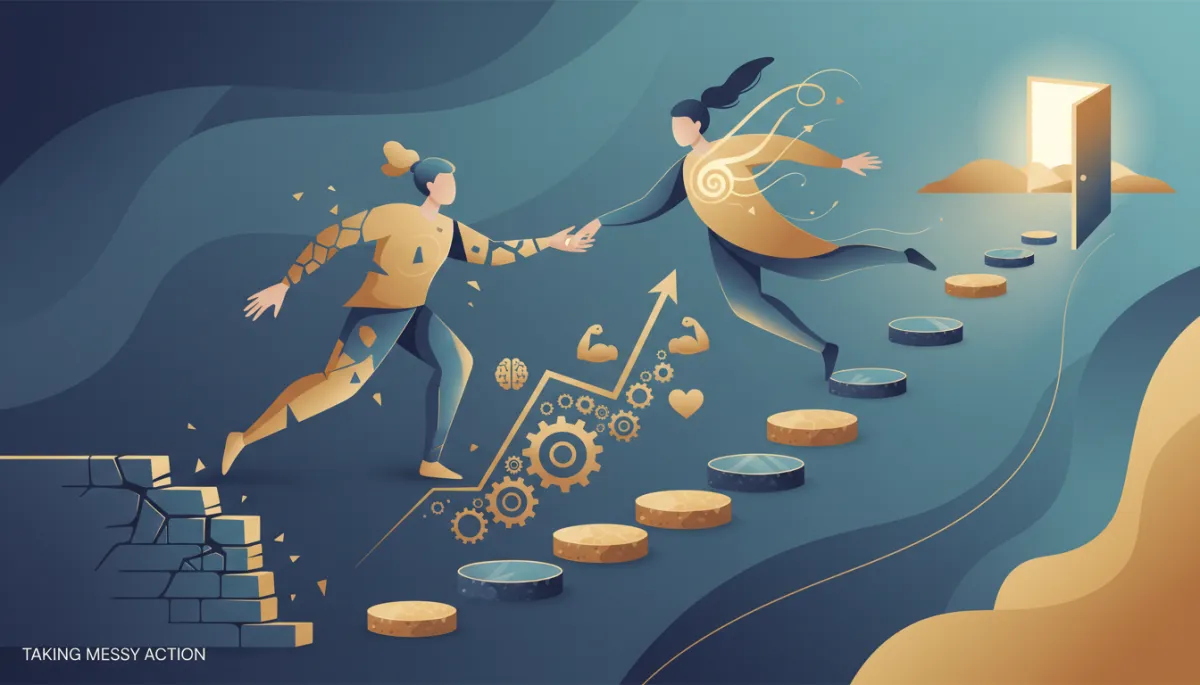
Entrepreneurs are the same. The ones you admire are not operating without fear. They’ve simply developed the habit of taking messy action in the presence of fear. They launch before they feel ready. They sell before their offer is perfect. They show up online even when they feel awkward. They hire before they know exactly how to manage. They are not fearless; they are willing
Messy action is also how you transform your body and your relationships. It’s not the flawless plan that changes your life; it’s the willingness to keep going after imperfect days. It’s the apology that isn’t worded perfectly but is sincere. It’s the workout that’s shorter than you planned but still happened. It’s the awkward first attempt at setting a boundary. Progress is built on a pile of imperfect, uncomfortable, deeply human attempts—not on a highlight reel of fearless perfection.
How Coaching Helps You Maintain Perspective When You Want to Run
One of the most powerful elements of Married at First Sight is the presence of experts—relationship coaches, therapists, and specialists who step in when things get messy. They don’t remove the discomfort; they help the couples interpret it. They reframe conflict as an opportunity to understand each other better. They remind participants why they signed up. They point out patterns the individuals can’t see themselves. They hold the bigger picture when the couple is stuck in the pain of the moment.
That’s exactly what good coaching does in entrepreneurship, weight loss, and personal growth. When you’re in the middle of a launch that isn’t working, your brain wants to make it mean something about your worth. A coach helps you zoom out: What are the numbers actually saying? What can we tweak? What did you learn? When you’ve fallen off your health plan, your brain wants to tell you, “See, you always fail.” A coach helps you see the single choice in context, not as a verdict on your identity. When you’re in a relationship conflict, your brain wants to protect you by attacking or withdrawing. A coach helps you stay curious instead of defensive.
Perspective is everything. Without it, discomfort feels like a stop sign. With it, discomfort becomes data. Coaching doesn’t make you immune to fear, rejection, or self-doubt; it gives you the tools to navigate them without burning your life down every time you feel triggered. It helps you keep moving toward the life you desire, even when your inner alarm system is blaring.
The Seductive Nature of Comfort (and Its Hidden Costs)
Comfort is seductive. It whispers, “Stay where you are. At least you know this.” On Married at First Sight, comfort looks like going back to old dating patterns, emotionally checking out, or sabotaging the relationship so you can say, “See? It never works out for me.” In entrepreneurship, comfort looks like staying in planning mode instead of selling, staying in your current income level instead of stretching, staying behind the scenes instead of being visible. In weight loss, comfort looks like quitting “for now” and promising you’ll start again Monday—for the 100th time.
Comfort feels safe, but it’s not free. It has hidden costs:
The cost of unrealized potential—never knowing what your business, your body, or your relationships could have been
The cost of self-trust eroding a little more every time you break a promise to yourself
The cost of living with a low-grade ache of “I know I’m meant for more than this”
The couples on the show who choose comfort over growth usually end up back where they started—single, guarded, convinced that nothing ever changes. The entrepreneurs who choose comfort over growth end up with beautifully organized Google Docs and no revenue. The person who chooses comfort over health ends up with more shame and less energy. Comfort is easy to choose in the moment, but over time, it’s incredibly expensive.
Where Are You Being “Stoppable”?
One of the most powerful questions you can ask yourself is: Where am I being stoppable? Not in theory, but in the actual details of your life. Where do you hit discomfort and stop? Where do you feel the sting of rejection and retreat? Where do you let fear make your decisions for you?
Maybe you’re stoppable when:
A post gets fewer likes than you hoped, so you stop posting for weeks
The scale goes up one day, so you throw away the whole plan
Your partner doesn’t respond exactly how you wanted, so you punish them with silence
A team member pushes back, so you avoid delegating altogether
Self-awareness is not about judging yourself; it’s about finally seeing the pattern clearly enough that you can choose something different. The participants on Married at First Sight who grow the most are the ones who say, “This is what I always do, and I don’t want to keep doing it.” That’s the moment transformation becomes possible. Not when everything is perfect, but when you’re honest about where you’ve been letting yourself be stoppable—and you decide to become just a little less stoppable today than you were yesterday.
Staying Open, Taking Messy Action, and Embracing Failure as Part of Growth
If there’s one thing Married at First Sight teaches over and over, it’s that staying open is a choice. Some couples walk into the experiment guarded and slowly learn to soften. Others arrive hopeful and then slam their walls up at the first sign of discomfort. The difference isn’t what happens to them; it’s how they respond. Staying open doesn’t mean ignoring red flags or tolerating harm. It means remaining willing to be honest, curious, and vulnerable, even when it would be easier to shut down and declare the whole thing a failure.
In entrepreneurship, staying open looks like:
Being willing to hear “no” and still make the next offer
Receiving feedback without collapsing into shame or defensiveness
Letting yourself be seen as a work in progress, not a finished product
Taking messy action means you don’t wait until you’ve figured it all out. You move, you learn, you adjust. You accept that failure is not a verdict; it’s a data point. Every couple on the show has awkward moments, miscommunications, and flat-out bad days. The ones who make it aren’t the ones who avoid those moments; they’re the ones who repair, learn, and keep choosing each other anyway. In the same way, you build the life you desire not by avoiding mistakes, but by building a relationship with failure that doesn’t end every time something goes wrong.
Building the Life You Desire: Your Own Social Experiment
When you strip away the cameras and the editing, Married at First Sight is just a group of people doing something radical: betting on the possibility that life can be bigger, deeper, and more meaningful than what they’ve known so far. They’re willing to look foolish, to be judged, to be misunderstood, in service of that possibility. That’s what building the life you desire actually looks like. It’s not polished. It’s not linear. It’s not always glamorous. It’s a series of choices to believe in something bigger than your current circumstances—and to back that belief with action, again and again.
Your business, your body, your relationships, your leadership—they are all parts of one life. You don’t have to choose between them. You don’t have to be perfect in any of them. You simply have to be willing to begin with hope, to stay when it gets hard, to lean into discomfort instead of interpreting it as a stop sign, to get support when your perspective narrows, and to keep taking messy, imperfect action in the direction of the life you actually want, not the one you’ve settled for.
Your Call to Action: Lean In When Things Get Hard
So yes, I love Married at First Sight. Not just because it’s entertaining, but because it reminds me, over and over, what courage actually looks like. It looks like saying “I do” when you don’t know how it’s going to turn out. It looks like staying at the table when you’d rather walk away. It looks like admitting your patterns and choosing differently. It looks like being willing to be seen, to fail, to try again.
Right now, there is an area of your life—your business, your health, your relationships, your leadership—where you are at that familiar crossroads. It’s uncomfortable. Maybe you feel rejected. Maybe you’re scared. Maybe you’re tempted to retreat back into comfort and tell yourself a familiar story about why this just isn’t for you. Before you do, pause and ask:
What if this discomfort is not a sign to stop, but a sign to lean in?
Where am I being stoppable—and what would one small, messy action look like today?
You don’t have to transform everything overnight. You just have to refuse to let fear, rejection, or temporary discomfort be the final word. Get support. Get perspective. Stay open. Take the next messy step. Let failure be part of the story, not the end of it. The life you desire is not built in the highlight moments; it’s built in the quiet, unseen decisions to lean in when it would be easier to pull away.
When it gets hard—and it will—remember the couples standing at that altar, hearts racing, not knowing how it will end, but choosing to believe in something bigger anyway. You can do the same in your own life. Lean in. This is where your real story starts.
