Discover What Truly Motivates You for Success
Leadership, Motivation, Performance
Success Distinction #3: Know What Motivates You
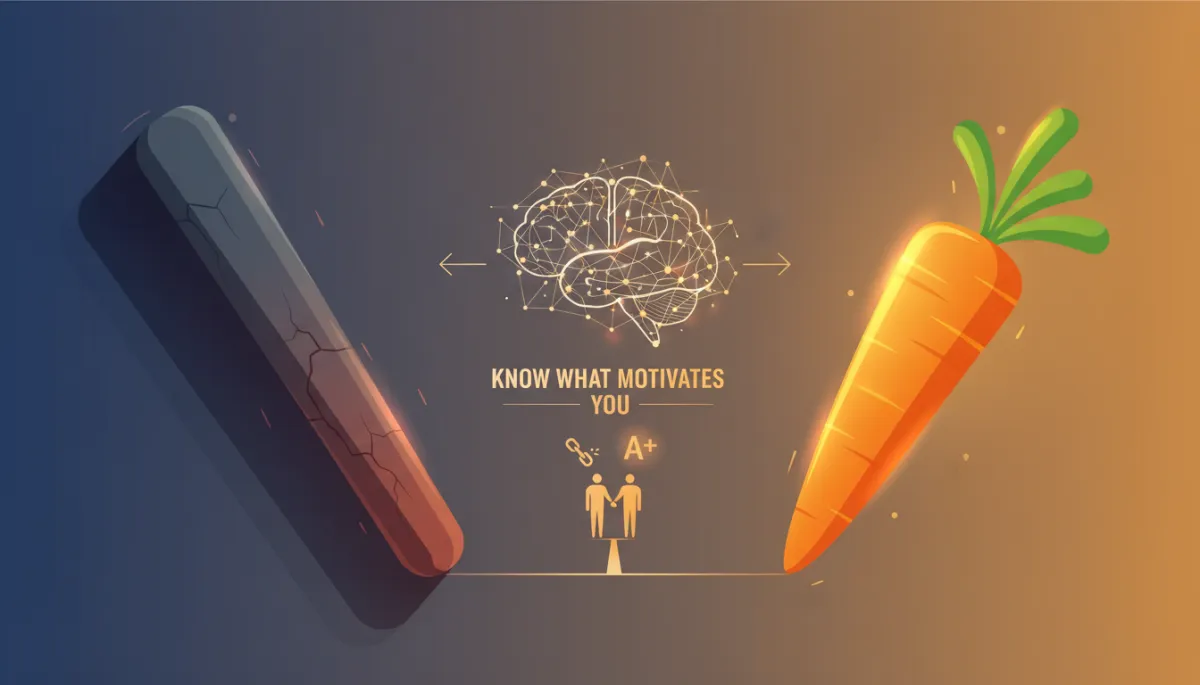
High-performing professionals rarely leave their motivation to chance. They understand exactly what gets them moving—whether it is a powerful reward (the big carrot) or a firm consequence (the big stick)—and they design their environment around that insight. This distinction is one of the quiet separators between people who talk about goals and those who consistently deliver results.
Why Knowing Your Motivation Is a Professional Advantage
You already know that motivation matters. What is often missed is that self-knowledge about your motivation matters even more. Two people can have the same role, the same resources, and the same objectives—and yet one consistently follows through while the other quietly falls behind. The difference is rarely intelligence or capability; it is usually clarity about what personally gets them to act.
When you understand your own motivational wiring, you stop trying to copy what works for other people and start building systems that actually work for you. Instead of forcing yourself into someone else’s routine or discipline style, you deliberately choose the triggers, rewards, and consequences that reliably move you from intention to execution. That self-awareness becomes a professional advantage because it turns your motivation from something unpredictable into something you can manage and design around.
The Big Carrot vs. the Big Stick: Which One Moves You?
At a simple level, most of us respond more strongly to one of two forces: the big carrot (a compelling reward or benefit) or the big stick (a meaningful consequence or cost). Both can work. The key is knowing which one actually gets you to move when it counts—not in theory, but in your real, day-to-day behavior.
When You Are a “Big Carrot” Person
If you are primarily motivated by the big carrot, you light up when you can see a clear, attractive payoff. You move faster when the reward is vivid: a promotion, a bonus, meaningful recognition, more autonomy, or even something personal like extra time with family or a long-awaited trip. You tend to ask questions like, “What will this allow me to do?” or “How will this improve my life or career?” The more concrete and emotionally appealing the answer, the easier it is for you to take action.
For big-carrot professionals, motivation drops when the reward is vague, distant, or purely theoretical. Generic goals such as “improve performance” or “be more strategic” do not create enough pull. You need to translate them into something you can actually picture and feel: “earn a role where I lead a team of five,” or “build a reputation as the go-to person for complex client issues.” When the carrot is specific and emotionally relevant, your energy rises and execution follows.
When You Are a “Big Stick” Person
If you are primarily motivated by the big stick, you move when there is a real cost to inaction. Deadlines, external commitments, and visible accountability wake you up. You may not love pressure, but without it, you tend to drift, delay, or endlessly refine instead of finishing. You respond strongly to the idea of what you might lose: credibility, opportunities, money, or even self-respect, if you do not follow through on what you said you would do.
Big-stick professionals often do their best work when there is a clear line between action and consequence. Give them a firm deadline, a stakeholder who is expecting a deliverable, or a visible commitment they have made publicly, and they deliver. Without that structure, goals can sit on a list for months or years. It is not laziness; it is simply that their motivational system is activated by pressure with teeth, not by well-meaning intentions alone.

Clear deadlines and visible commitments turn vague intentions into concrete action.
How Awareness of Your Style Drives Accountability and Results
Simply knowing whether you lean toward the big carrot or the big stick can dramatically change your results. That awareness allows you to design accountability around your natural tendencies instead of fighting against them. You stop relying on willpower and start relying on structure.
Turning Self-Knowledge into Practical Accountability
For big-carrot professionals, accountability works best when it is tied to a visible, meaningful benefit. You might:
Connect each major task to a specific professional gain—skill growth, visibility, or future opportunities—so you remember why it matters.
Build in short-term rewards for progress, such as protected time for a passion project once key milestones are complete.
Share your goals with a mentor or leader who can highlight how your progress aligns with bigger opportunities.
For big-stick professionals, accountability is most effective when it introduces real consequences for inaction. You might:
Commit publicly to a deadline with your manager, team, or a peer, so non-delivery has a visible impact on your reputation.
Schedule regular check-ins where you must show progress, not just talk about plans, creating social pressure to follow through.
Attach a personal cost to missing a commitment—for example, donating to a cause you do not support if you do not hit a milestone.
💡 Pro Tip: Neither style is “better.” The professionals who win are the ones who stop judging their motivational wiring and start using it deliberately.
Why Vague Goals Fail: The Need for Clear Consequences
Many talented professionals carry a list of “important” goals that never seem to move. The problem is not usually the goal itself; it is the absence of clear consequences for inaction. When nothing meaningful happens if you delay, your brain quietly learns that the goal is optional. And optional goals are the first to be pushed aside by urgent emails, meetings, and other people’s priorities.
Clear consequences do not have to be harsh, but they do have to be real. “I should really work on that presentation” carries no weight. Compare that to “If I do not refine this presentation by Friday, I will walk into the leadership meeting underprepared and risk undermining my credibility.” One statement is a wish; the other introduces a cost. The second is far more likely to get you to sit down and do the work, even when you are not in the mood.
Designing Consequences That Support, Not Sabotage
Clear consequences are not about punishing yourself; they are about making the stakes visible. You can design them to be firm yet constructive. For example:
If you miss a self-imposed deadline, you must reschedule a leisure activity to create uninterrupted time to finish the work.
If you do not complete a strategic task this week, you agree to tackle it first thing Monday before checking email.
If you skip a planned development activity, you must explain why to a mentor or colleague whose opinion you value.
The point is not to make your life miserable; it is to align your daily decisions with what you say matters most. Without consequences, even your most important goals can quietly slide to “someday.” With them, you create a gentle but persistent pressure that keeps you honest about your priorities.
A Simple Exercise: Discover Your Primary Motivator by Tomorrow
Awareness is only powerful if you turn it into action. To make this distinction real, give yourself a clear, short deadline: by tomorrow, you will identify whether you are more of a big-carrot or big-stick professional and design one concrete change based on that insight. Here is a simple exercise to guide you.
Step 1: Review Your Recent Behavior, Not Your Beliefs
Today, take ten minutes to look back over the last three months of your work. Choose two or three situations where you:
Delivered something important ahead of schedule or at a very high standard.
Finally took action on something you had been delaying for a while.
For each example, ask yourself: What actually got me moving? Was it the promise of something positive (recognition, a new opportunity, relief, pride) or the pressure of something negative (a looming deadline, fear of letting someone down, concern about consequences)? Answer honestly based on what you did, not how you wish you were motivated.
Step 2: Name Your Primary Driver
By tomorrow, write a single sentence that captures your primary driver. For example:
“I do my best work when I can see a concrete, meaningful reward for finishing.”
“I do my best work when there is a real consequence for not delivering.”
Keep this sentence visible—on a note by your desk, in your planner, or as a reminder on your phone. This is not a label to box you in; it is a tool to help you make faster, smarter decisions about how to structure your commitments and environment.
Step 3: Design One New Motivational Structure
Before tomorrow ends, choose one important professional goal you have been postponing—a certification, a strategic project, a difficult conversation, a process improvement—and create a motivational structure that fits your style.
If you are a big-carrot person, define a specific reward and a vivid picture of what success will give you. Write down what will be better in three to six months if you follow through this week.
If you are a big-stick person, create a real consequence for not acting. Set a public deadline, enlist a colleague, or introduce a cost you will genuinely feel if you do not move forward.
The goal is not to overhaul your entire life in twenty-four hours. It is to prove to yourself that when you respect your own motivational wiring, you can change your behavior quickly. One well-designed structure, aligned with your natural driver, is more powerful than a dozen vague intentions.
Bringing It All Together: Make Motivation a Conscious Choice
Success Distinction #3—know what motivates you—is not about putting yourself into a rigid category. It is about taking ownership of the forces that already shape your behavior. Whether you are more responsive to a big carrot or a big stick, your motivation is not random. It follows patterns. When you see those patterns clearly, you can use them instead of being used by them.
Understanding your personal motivation sharpens your accountability. You stop relying on vague promises to “do better” and start building conditions where doing better becomes the natural outcome. You deliberately create rewards that pull you forward and consequences that keep you honest. You treat your motivation as a professional tool, not a mysterious mood that you hope will show up on the right days.
📌 Key Takeaway: Motivation is not something you wait for; it is something you design. The design starts with knowing which lever—carrot or stick—actually works for you.
So give yourself a clear, simple challenge: by tomorrow, decide—based on your real behavior—whether you are primarily motivated by the big carrot or the big stick. Then, choose one meaningful goal and create either a compelling reward or a firm consequence around it. Do not overthink it. Take one concrete step that respects how you are wired, and notice what happens to your follow-through.
Professionals who make this distinction—and act on it—separate themselves over time. They are not more disciplined by nature; they are more deliberate by design. They know what motivates them, they build it into their daily environment, and as a result, they consistently turn intentions into measurable results. Starting today, you can do the same.
