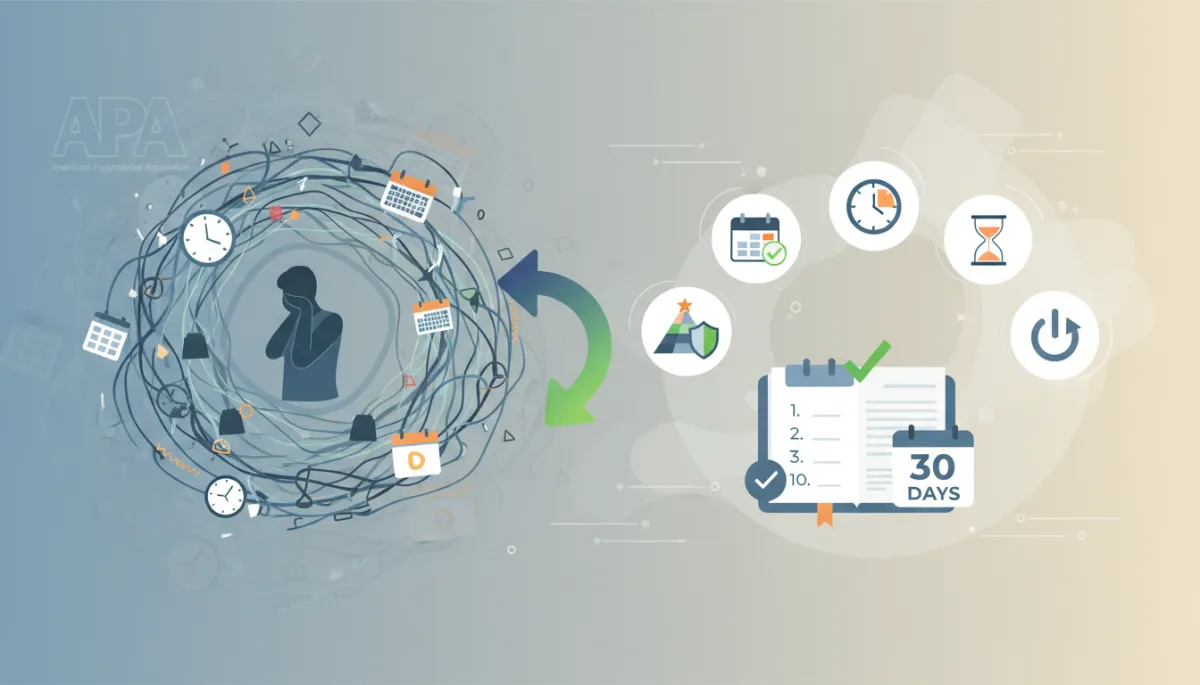
Escape Stress: Reclaim Time & Boost Productivity
Stress Management, Productivity, Mental Health
Living on the Edge: How to Escape Everyday Stress and Take Back Your Time
Stress has become the background noise of modern life. But it doesn’t have to be. With a few simple, practical shifts, you can lower your stress, reclaim your focus, and start enjoying your days again.
America’s Stress Problem: Why “Busy and Overwhelmed” Feels So Normal
According to the American Psychological Association (APA), stress levels in the United States are consistently high. Their recurring Stress in America surveys show that a large share of adults report feeling significant stress about money, work, health, family responsibilities, and the future. Many say their stress levels are so high that it impacts their sleep, mood, and ability to function day to day.
Over the past several years, the APA has highlighted a troubling pattern: most Americans are living with chronic, elevated stress. It’s not just the occasional bad week. It’s an ongoing state of tension, pressure, and overload that people have started to accept as “just how life is now.”
When stress becomes constant, it stops being a helpful response to a tough situation and turns into a lifestyle. You might recognize it in phrases like:
“I’m always behind.”
“There’s never enough time.”
“Once I get through this week, things will calm down” (but they never do).
The truth is, the culture of constant busyness trains us to believe that living under high stress is normal, even admirable. Yet your body and mind are paying a real price for that belief.
The Hidden Symptoms of Overwhelm You Might Be Ignoring
Overwhelm doesn’t always show up as a dramatic breakdown. More often, it looks like a slow leak in your energy, focus, and joy. You may be functioning on the outside, but on the inside, you feel like you’re barely holding it together. Common symptoms of overwhelm include:
Constant mental noise. Your brain never quiets down. You’re always thinking about the next thing, replaying conversations, or worrying about what you forgot to do.
Decision fatigue. Even small choices—what to eat, whether to answer a text, which task to start—feel strangely heavy or exhausting.
Short fuse. You find yourself snapping at people you care about, or feeling irritated by things that wouldn’t normally bother you when you’re rested and calm.
Procrastination and paralysis. You have so much to do that you don’t know where to start, so you scroll your phone, shuffle papers, or bounce between tasks without finishing anything.
Sleep problems. You’re tired but wired. You struggle to fall asleep, wake up in the night, or start the day already exhausted and behind.
Physical tension. Tight shoulders, clenched jaw, headaches, stomach issues, or a general sense that your body is always bracing for impact.
If you recognize yourself in several of these, your stress load is likely too high. You may not think of it as “stress” anymore—just your normal baseline. But normal doesn’t mean healthy, and it definitely doesn’t mean necessary.

Simplifying your tools and priorities is a powerful antidote to daily overwhelm.
Why You Don’t Have to Tolerate a Life of Constant Stress
A certain amount of stress is unavoidable. Deadlines, bills, health concerns, and responsibilities are part of being human. But the idea that you must live in a near-permanent state of pressure is simply not true. Much of the stress we carry isn’t caused by the events themselves—but by how we organize our lives around them (or don’t).
Here’s the hopeful part: a surprising portion of everyday stress is optional. It comes from:
Disorganized schedules and scattered information
Vague priorities and unclear expectations of yourself
Letting other people’s requests run your day instead of your own values and goals
Not giving your brain time to reset and recharge
None of those are fixed facts about your life. They are patterns—and patterns can be changed. You may not be able to control everything that comes your way, but you can control how you structure your time, attention, and energy around it. You don’t have to wait until you burn out to make a change. You can start building a calmer, more focused life today with small, practical steps.
📌 Key Takeaway: High stress may be common, but it is not inevitable. You have more control than you think over how chaotic or calm your days feel.
Five Super-Easy Daily Hacks to Lower Stress and Boost Productivity
You don’t need a total life makeover to feel less stressed. Often, a few simple systems can dramatically reduce mental clutter and help you get more done with less effort. Below are five super-easy, practical hacks you can start using right away. Each one is designed to give your brain less to track, your schedule more structure, and your day more breathing room.
Hack #1: Use Just One Calendar
Many people are more stressed than they need to be for one simple reason: their life is scattered across multiple calendars and lists. A work calendar here, a family calendar there, appointments in email, reminders on your phone, sticky notes on the fridge, and mental “don’t forgets” swirling in your head. No wonder you feel overwhelmed—your brain is constantly scanning for what you might be missing.
The fix: commit to using just one calendar for everything that is time-based. That means:
Work meetings and deadlines
Medical appointments and personal commitments
Family events, school activities, social plans, and recurring routines like workouts or classes
It doesn’t matter whether your calendar is digital or paper. What matters is that it’s the single source of truth for your time. When everything lives in one place, your brain stops doing constant detective work to figure out what’s next. You can simply look at your calendar and trust it.
💡 Pro Tip: For two weeks, every time you catch yourself thinking, “I need to remember that,” pause and immediately add it to your one calendar instead. Train your brain to trust the system, not your memory.
Hack #2: Apply Time Blocking (So Your Day Has a Shape)
One of the most stressful ways to move through the day is to treat every hour like a free-for-all. You respond to whatever feels urgent in the moment—emails, messages, interruptions, random tasks—without a clear sense of when important work will happen. By the end of the day, you’ve been busy, but your priorities are still untouched. That gap between effort and results is exhausting.
Time blocking is a simple way to give your day structure. Instead of asking, “What should I do now?” every few minutes, you decide in advance when you’ll focus on specific types of work. Think of it as giving each part of your day a job description.
A basic time-blocked day might look like this:
8:00–9:00 a.m. – Planning and email triage
9:00–11:00 a.m. – Deep work on your most important project (no meetings, minimal distractions)
11:00–12:00 p.m. – Meetings or calls
1:00–2:00 p.m. – Admin tasks, quick responses, small to-dos
2:00–4:00 p.m. – Focus block #2 for priority work or planning
You don’t need a perfect schedule. The goal is simply to tell your time where to go instead of letting it scatter itself. Time blocking reduces stress because you no longer have to constantly decide what to do next; you follow the plan you already made with a clear head.
Hack #3: Guard Your Time Like a Valuable Resource (Because It Is)
Much of our stress doesn’t come from how much we have to do—it comes from the constant interruptions and unplanned demands that slice our time into tiny pieces. Every “Got a minute?” at work, every unexpected favor, every notification that pulls you away from what you were doing forces your brain to switch gears. That mental switching is tiring and makes everything feel harder than it needs to be.
Guarding your time doesn’t mean becoming rigid or selfish. It means recognizing that your time and attention are limited, and choosing to spend them intentionally. A few simple ways to guard your time:
Set expectations. Let colleagues, clients, or family know when you are and aren’t available. For example: “I’m heads-down on a project from 9:00 to 11:00, but I’ll be free to talk after that.”
Batch communication. Instead of checking email or messages all day long, pick one to three windows when you respond in batches. The rest of the time, turn off notifications and focus on what matters most.
Practice “let me get back to you.” When someone asks for your time, resist the urge to say yes immediately. Try: “Let me check my schedule and get back to you.” Then decide if it truly fits your priorities and capacity.
Every time you protect a block of focused, uninterrupted time, you lower your stress and increase your sense of control. You’re no longer at the mercy of everyone else’s agenda.
Hack #4: Set Clear Priorities (So You’re Not Trying to Do Everything)
One of the fastest ways to feel overwhelmed is to treat every task as equally important. When your to-do list has twenty items and they all feel urgent, your brain goes into crisis mode. You spin your wheels, jump between tasks, and end the day wondering why you didn’t make real progress on anything that matters.
Clear priorities are like a filter. They help you decide what deserves your limited time and energy, and what can wait, be delegated, or be dropped altogether. Instead of asking, “Can I fit this in?” you start asking, “Does this align with what matters most right now?”
Here’s a simple way to set priorities:
List everything that’s on your mind—work tasks, personal responsibilities, errands, goals, projects, worries. Get it all out of your head and onto paper or a document.
From that list, circle the Top 10 priorities for the next 30 days. These are the things that, if you made meaningful progress on them, would truly move your life or work forward.
Next, star your Top 3 for this week. These are your non-negotiables—the tasks or projects you will protect time for, even if other things have to wait.
When you know your Top 10 and your Top 3, it becomes much easier to say no to distractions and low-impact tasks. You’re not just reacting; you’re choosing. That sense of direction is incredibly calming, even when life is full.
Hack #5: Reboot Regularly (Don’t Wait Until You Crash)
Computers run more smoothly when they’re rebooted regularly. So do people. Yet many of us treat rest like a reward we might get someday, instead of a requirement for functioning well. We wait until we’re exhausted, sick, or burned out before we give ourselves permission to stop and reset.
A reboot is any intentional pause that allows your brain and body to reset. It doesn’t have to be dramatic or time-consuming. In fact, small, frequent reboots are often more effective than rare, big breaks. Consider building in:
Mini reboots during the day. Stand up, stretch, walk around the block, drink water, or take five slow breaths with your eyes closed. Two to five minutes is enough to interrupt the stress cycle and bring your nervous system down a notch.
Daily reboots. Create a simple morning or evening routine that signals to your brain: “We’re starting fresh” or “We’re done for today.” It might be journaling, reading, light stretching, or a short walk without your phone.
Weekly reboots. Choose one block of time each week—an evening, an afternoon, or a morning—where you deliberately step away from productivity mode. No catching up, no multitasking. Just rest, play, or connection.
Rebooting doesn’t make you “fall behind.” It makes you more effective when you’re on. A rested brain makes better decisions, works faster, and handles stress with more resilience. Rest is not the opposite of productivity—it’s the foundation of it.
Putting It All Together: A Simpler, Calmer Way to Run Your Days
Each of these hacks—using one calendar, time blocking, guarding your time, setting clear priorities, and rebooting—is simple on its own. The real power comes when you combine them. Together, they create a framework for a calmer, more intentional life:
Your one calendar holds your commitments, so you’re not living in fear of what you might forget.
Time blocking gives your day a shape, so you know when important work will happen instead of hoping it magically fits in.
Guarding your time protects your focus from constant interruptions and unplanned demands.
Clear priorities guide your decisions, so you’re working on what truly matters instead of everything at once.
Regular reboots keep your mind and body from running on empty, so you can show up with more energy and clarity.
None of this requires a personality transplant or a complicated app. These are small, human, doable shifts. They don’t erase every source of stress in your life, but they dramatically reduce the unnecessary stress created by disorganization, unclear priorities, and constant urgency.
Your 30-Day Challenge: Choose One Hack and Commit
Reading about stress won’t change your life. Taking one small, consistent action will. To help you move from insight to transformation, here’s a simple challenge you can start today.
Step 1: Create Your Top 10 Priority List
Set aside 15–20 minutes in a quiet spot. Grab a notebook, open a document, or use your favorite notes app. Then:
Brain-dump everything that’s on your mind for the next month—projects, tasks, worries, hopes, responsibilities, and ideas.
From that list, choose your Top 10 priorities for the next 30 days. These should be a mix of work and personal items: the things that would genuinely improve your life, reduce your stress, or move your goals forward if you made real progress on them.
Write those Top 10 clearly on a single page or screen. This is your personal roadmap, your filter, and your anchor when life gets noisy.
Step 2: Pick One Productivity Hack to Practice for 30 Days
Next, choose one of the five hacks from this article to focus on for the next 30 days:
Using just one calendar
Applying time blocking to your days
Guarding your time with clearer boundaries
Setting and reviewing clear priorities (Top 10 and weekly Top 3)
Building in regular reboots (daily and weekly)
Don’t try to master all five at once. That’s a recipe for more stress, not less. Instead, ask yourself: “Which one of these, if I did it consistently for a month, would make the biggest difference in how I feel day to day?”
Step 3: Make Your Commitment Specific and Visible
Once you’ve chosen your hack, turn it into a clear, simple commitment. For example:
“For the next 30 days, I will use one digital calendar for all my appointments and check it every morning and evening.”
“For the next 30 days, I will time-block my mornings from 9:00–11:00 a.m. for deep work on my Top 3 priorities.”
“For the next 30 days, I will create a weekly Top 3 and review it every morning before opening email.”
Write your commitment down where you’ll see it daily—on a sticky note, in your planner, as your phone lock screen, or on a card by your desk. The more visible it is, the easier it will be to follow through, even on busy days.
Step 4: Check In with Yourself Each Week
Once a week, take five minutes to ask:
How often did I follow through on my chosen hack?
When I did, how did my stress level and focus feel?
What small adjustment would make it easier to keep going next week?
Progress doesn’t require perfection. If you miss a day, don’t abandon the experiment. Simply notice what got in the way, adjust if needed, and pick it back up the next day. Consistency over time is what rewires your habits and lowers your stress baseline.
You Deserve More Than a Life of “Barely Coping”
The APA’s findings are clear: most Americans are carrying stress levels that are too high for too long. But statistics are not destiny. You are not required to live in a constant state of rush, pressure, and exhaustion just because it’s common. You can choose a different way to move through your days—one that honors your time, your energy, and your well-being.
Start small. Give yourself the gift of a single calendar you can trust, a day with a clear shape, protected pockets of focus, priorities that make sense, and regular moments to reboot. These aren’t luxuries; they’re practical tools for a healthier, more productive life.
Call to Action: Today, complete your Top 10 Priority list for the next 30 days. Then choose one productivity hack from this article and commit to practicing it daily for the next 30 days. Put your commitment somewhere you can see it, and watch how even this single change begins to lower your stress and increase your sense of control.
You don’t have to wait for a less stressful season to feel better. You can start creating it—one calendar entry, one time block, one protected hour, one clear priority, one reboot at a time—starting right now.
