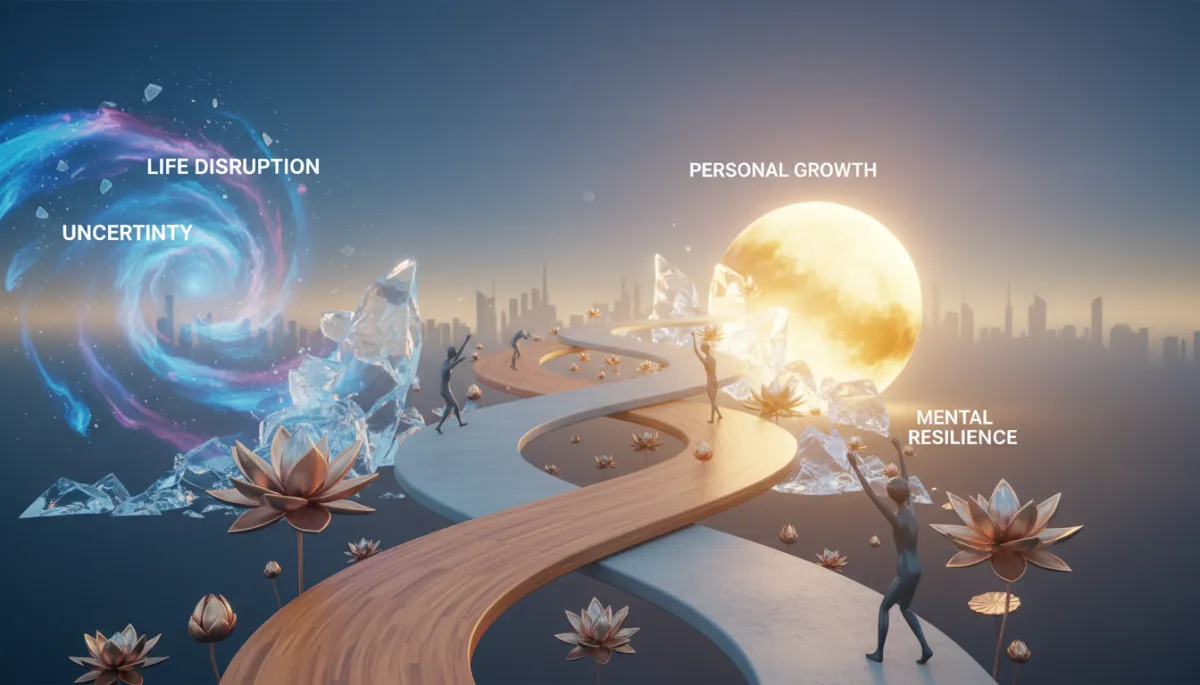
Embrace Change: Turn Uncertainty into Growth
Life Disruption, Embracing Change, Mental Resilience, Personal Growth, Navigating Uncertainty, Overcoming Obstacles
When Life Disrupts Your Plans: Turning Uncertainty into Personal Growth
Careers stall, relationships shift, economies wobble, health changes without warning. Life disruption is no longer the exception; it’s the environment we work and live in. Yet within every unexpected change lies an invitation—to build mental resilience, to navigate uncertainty with intention, and to grow into a stronger, more grounded version of yourself.
Understanding Life Disruption: When the Ground Shifts Beneath You
Life disruption can arrive quietly or crash in without warning. A restructuring at work, a sudden move, a breakup, a health diagnosis, a global crisis—each pulls you out of the familiar and into a space where your usual assumptions no longer hold. For professionals who value control, planning, and performance, disruption can feel like personal failure, even when it has nothing to do with your competence or effort.
It helps to name disruption for what it is: a break in continuity, not a verdict on your worth. When the story you were writing for your life suddenly changes, it is natural to feel disoriented. You might notice yourself asking:
“Who am I without this role, this relationship, or this routine?”
“What happens to the plans I worked so hard to build?”
“How do I move forward when the path ahead is unclear?”
These questions are not signs of weakness. They are signs that your inner world is updating to match a new reality. Rather than rushing to “get back to normal,” consider that disruption may be offering you a different opportunity: to design a new normal aligned more closely with your values, strengths, and aspirations.
💡 Reflection Prompt: Think of a past disruption that felt overwhelming at the time. What unexpected strengths or insights eventually emerged from that season?
Embracing Change: Moving from Resistance to Partnership
Our first instinct in the face of change is often resistance. We cling to familiar routines, roles, and identities because they feel safe. Yet clinging tightly to the past can drain your energy and cloud your judgment at the very moment you need clarity most. Embracing change does not mean pretending to enjoy every challenge; it means choosing to work with reality instead of against it.
You begin to embrace change when you shift from asking, “Why is this happening to me?” to “Given that this is happening, who do I want to be in response?” That subtle shift restores a sense of agency. You may not control the disruption, but you do control your orientation toward it—curious or closed, flexible or rigid, proactive or reactive. This mindset is the foundation of mental resilience and sustainable personal growth.

Intentional reflection transforms raw disruption into meaningful direction and growth.
Embracing change also involves acknowledging loss. Even positive transitions—like a promotion, relocation, or new opportunity—can carry grief for what you are leaving behind. Giving yourself permission to feel both excitement and sadness is not indulgent; it is honest. That honesty frees emotional energy you can then invest in exploring what this new chapter makes possible for your career, relationships, and sense of purpose.
📌 Key Takeaway: Embracing change is less about liking what is happening and more about choosing how you will show up within it.
Overcoming Obstacles: Turning Setbacks into Stepping Stones
Every disruption brings a series of obstacles—practical, emotional, and sometimes financial. Deadlines shift, income changes, support systems move, and your own confidence may waver. Overcoming obstacles is not about pushing yourself relentlessly; it is about approaching challenges with strategy, self-compassion, and a willingness to adapt your plan without abandoning your vision.
A helpful approach is to break obstacles into three categories:
External obstacles – structural or situational factors such as company downsizing, industry shifts, caregiving responsibilities, or resource constraints. These require creativity, negotiation, and sometimes the courage to change environments entirely.
Skill-based obstacles – gaps in knowledge or capability, like needing new technical skills, leadership abilities, or communication tools. These invite you to invest in learning and development as a direct route to personal growth.
Internal obstacles – beliefs, fears, and narratives that keep you stuck. Thoughts like “I’m too late,” “I’m not ready,” or “I always mess this up” can quietly undermine even the best strategies. Addressing these is central to building mental resilience.
When you encounter an obstacle, pause and ask: What type of obstacle is this, and what specific support would help me move through it? That question shifts you from self-criticism to problem-solving. It also opens the door to seeking support—from mentors, peers, coaches, mental health professionals, or trusted friends—rather than trying to carry everything alone.
💡 Pro Tip: Treat each obstacle as data. Instead of asking “What’s wrong with me?” ask “What is this challenge revealing about what I need next?”
Mental Resilience: Building Inner Strength for Uncertain Times
Mental resilience is not about being unshakable; it is about being able to bend without breaking. In seasons of disruption, resilience allows you to experience stress, disappointment, and fear without losing connection to your values or your capacity to act. It is a skill set you can cultivate, not a trait you either have or lack.
Consider a few practical resilience-building practices you can integrate into a demanding professional life:
Emotional literacy. Regularly name what you are feeling—stress, grief, frustration, hope, relief. Labeling emotions reduces their intensity and helps you respond thoughtfully instead of reacting on autopilot.
Grounding routines. Small, consistent habits—like a morning walk, a few minutes of breathing before meetings, or a nightly reflection—anchor you when external events feel volatile. These rituals remind your nervous system that you are safe enough to think clearly and make deliberate choices.
Self-compassionate self-talk. Notice the tone of your inner voice when plans change or you make a mistake. Replacing “I should have handled this better” with “I’m learning how to handle this better” keeps you moving forward instead of stuck in shame.
Mental resilience also involves setting boundaries. When life disruption demands more of your energy, you may need to say no more often, delegate more intentionally, or renegotiate expectations at work and at home. Protecting your capacity is not selfish—it is a responsible strategy for navigating uncertainty without burning out.
“Resilience is not about how fast you bounce back, but about how deeply you learn while you are down.”
— Adapted from modern resilience research
Navigating Uncertainty: Leading Yourself When the Map Is Incomplete
Uncertainty is uncomfortable because it exposes the limits of prediction and control. As professionals, we are often rewarded for having answers, delivering certainty, and reducing risk. Yet in times of disruption, honest leadership—of yourself and others—requires a different skill: the ability to move forward with incomplete information while staying grounded in your values and priorities.
One practical way to navigate uncertainty is to distinguish between what is known, what is unknown, and what is unknowable right now. You might not know how your industry will evolve over five years, but you may know the skills that are consistently valuable, the relationships that support you, and the personal boundaries that keep you healthy. Focusing on the sphere of influence you do have helps you act with intention instead of spiraling into worry.
Another powerful approach is to make reversible decisions where possible. Rather than waiting for perfect clarity, you can take smaller, low-risk steps that generate new information. Pilot a new project before fully committing. Test a different routine for a few weeks. Explore a side learning path before changing careers. Each small experiment helps you gather data, refine your direction, and build confidence that you can adjust as you go.
💡 Reflection Prompt: Where in your life are you waiting for certainty before you act? What is one small, reversible step you could take this week instead?
Personal Growth: Redefining Success in Seasons of Change
Disruption often forces a deeper question to the surface: What does success mean to me now? The metrics you used in a more stable season—title, income, speed of progression—may not fully capture what matters to you in a time of change. Personal growth invites you to broaden your definition of success to include inner qualities: courage, integrity, presence, empathy, and the capacity to adapt without losing yourself.
In practical terms, personal growth during disruption might look like:
Choosing to have a difficult but honest conversation instead of avoiding conflict.
Allowing yourself to rest without guilt so you can return to your work with clarity and focus.
Seeking feedback from colleagues and mentors to understand how your strengths show up under pressure.
Investing in learning that stretches you beyond your comfort zone, even when the payoff is not immediate.
Growth is rarely linear. You may feel strong and centered one week, then discouraged the next. That fluctuation does not mean you are failing; it means you are human. When you zoom out, you may notice that you are gradually becoming someone who can hold more complexity, respond more thoughtfully, and trust yourself more deeply—even when the future is unclear.
Practical Framework: A Reflective Approach to Life Disruption
To bring these ideas together—life disruption, embracing change, overcoming obstacles, mental resilience, navigating uncertainty, and personal growth—it can help to use a simple reflective framework. Consider these four steps as a guide you can return to whenever life shifts unexpectedly:
Notice. Acknowledge what has changed—externally and internally. Name your emotions, identify the disruptions, and give yourself permission to feel unsettled without demanding instant solutions.
Orient. Reconnect with your values. Ask, “What matters most to me in how I move through this?” Let your values—not fear—set your direction, even if the path is not yet clear.
Experiment. Take small, meaningful actions aligned with your values. Focus on reversible decisions and learning, not perfection. Let each step teach you something about what works and what does not.
Integrate. Pause regularly to reflect. What strengths have surfaced? What limiting beliefs have you outgrown? How has your definition of success evolved? Integration turns experience into wisdom.
📌 Key Takeaway: You do not need a five-year plan to move forward. You need a clear sense of who you want to be in this season and the courage to take the next honest step.
Bringing It All Together: Writing Your Next Chapter with Intention
Life disruption can feel like an eraser across the page of your plans. Yet, viewed with compassion and curiosity, it can also act as an editor—removing what no longer fits and creating space for a more authentic story to emerge. Embracing change, overcoming obstacles, and cultivating mental resilience are not separate projects; they are threads of the same tapestry: your ongoing personal growth.
As a professional, you bring discipline, experience, and commitment to your work. Those same qualities can serve you powerfully in your inner life. You can approach uncertainty as a strategic challenge, design supportive routines as you would a project plan, and seek feedback on your growth just as you would on your performance. The difference is that this project—your well-being and evolution—is one you carry into every role, organization, and season of life.
Wherever you find yourself right now—navigating a career pivot, adapting to new responsibilities, rebuilding after loss, or simply sensing that a change is coming—you are not behind. You are on a path that countless others have walked in their own way: from disruption to resilience, from uncertainty to clarity, from old definitions of success to deeper, more grounded ones. Your task is not to control every twist in the road, but to keep choosing who you will be as you walk it.
💬 Final Reflection: If you were to describe this season of your life as a chapter title, what would you call it? What is one small, courageous action that would be worthy of that title?
You do not have to wait until everything is resolved to grow. Growth is happening now—in the questions you are asking, in the boundaries you are learning to set, in the resilience you are quietly building each day you decide to keep going. When life disrupts your plans, let it also awaken your capacity to redesign them with more wisdom, more courage, and more alignment with who you are becoming.
