
Create a Meaningful Life with Your Ideals
Personal Growth, Life Purpose, Values, Self-Discovery
How to Create a Meaningful Life Around Your Highest Ideals and Roles
You were not made to drift through life reacting to whatever comes next. You were made to live with intention, to express your deepest values, and to bring something uniquely beautiful into the world. This guide will walk you step by step through a simple but powerful process to clarify what matters most, define your key life roles, and craft a personal mission statement that you can read every day to align your life with your highest ideals and purpose.
Why Living by Your Highest Ideals Changes Everything
Many people move through their days on autopilot. They react to emails, deadlines, family needs, and social media, hoping that meaning will somehow appear along the way. But a meaningful life is not an accident. It is created—deliberately—by aligning your choices with your highest ideals and the roles you are called to play.
When you are clear on what truly matters to you, every decision becomes easier. You know what to say yes to, what to say no to, and why. You stop chasing every opportunity and start choosing the ones that fit who you are and who you are becoming. This is the heart of creating a life of significance rather than just a life of activity.
💡 Pro Tip: You do not have to “have it all figured out” to begin. You just need a willingness to be honest with yourself and to put your deepest truths into words.
Step 1: Identify the Words That Represent What Matters Most to You
Start with a simple but powerful exercise: a word list. Your goal is to capture, in words, the qualities, principles, and ideals that feel deeply important to you. These might be classic values like integrity, faith, or creativity, or they might be more personal words like adventure, gentleness, or excellence. There are no “right” or “wrong” words—only words that ring true for you.
How to Create Your Personal Values Word List
Set aside quiet time. Find 15–20 minutes where you will not be interrupted. Bring a notebook or open a blank document on your device. Take a few deep breaths and give yourself permission to be honest, even if what you write surprises you.
Brainstorm freely. Begin listing words that feel important, beautiful, or compelling to you. Do not edit or judge yet. Just write. You might include words like: integrity, compassion, courage, faith, family, creativity, service, wisdom, growth, joy, justice, generosity, peace, excellence, loyalty, authenticity, beauty, learning, adventure, kindness, presence, hope, love.
Use prompts to go deeper. If you get stuck, ask yourself:
“When I admire someone, what qualities am I really admiring?”
“When I feel proud of myself, what am I living out?”
“When I feel disappointed in myself, what value did I ignore or betray?”
Keep writing until you have at least 20–30 words. More is fine. The goal is to get a rich picture of what matters to you before we begin narrowing it down.
📌 Key Takeaway: Your word list is a mirror. It reflects what your heart already knows is important, even if your schedule has not caught up yet.
Step 2: Choose Your Top 3–5 Foundation Values
Now it is time to narrow your list. The goal is to identify 3–5 foundation values—the core principles that you want your entire life to rest on. These are the values you would fight for, the ones you want to be remembered for, the ones that feel non‑negotiable at the deepest level. Think of them as the pillars that hold up the house of your life.
How to Select Your Foundation Values
Circle your “must‑haves.” Look at your longer list and circle every word that feels essential. Ask, “If this disappeared from my life, would I still be me?” You may end up with 10–15 circled words.
Group similar words. Many words overlap. For example, kindness, compassion, and mercy may all fit under a broader value like love. Achievement, excellence, and growth might cluster under purpose or mastery. Grouping helps you see patterns and avoid duplicates.
Ask clarifying questions. For each remaining word, ask:
“If I had to choose between this value and another, which would I choose?”
“Which values feel like the roots, and which feel like branches?”
The roots are your foundation values.
Commit to 3–5 words. After reflection, choose your top 3–5. Write them clearly on a fresh page, perhaps like this:
Faith – Integrity – Creativity – Compassion – Growth.
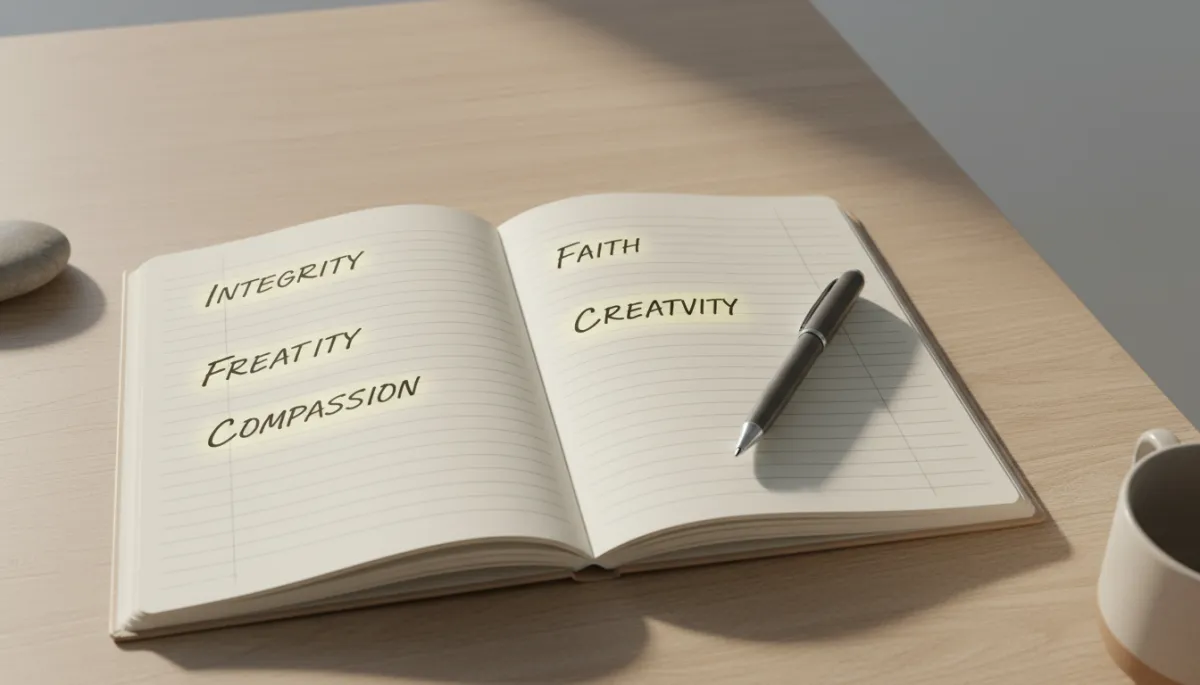
Clarifying 3–5 foundation values gives your daily choices a clear direction.
💡 Pro Tip: If you feel torn between two values, ask yourself which one naturally includes the other. Often one is the deeper source and the other is an expression of it.
Step 3: List All the Roles You Play in Life
Values answer the question, “What matters most to me?” Roles answer a different but equally important question: “Where do I live these values out?” You do not live your values in the abstract. You live them as a parent, a partner, a friend, a professional, a neighbor, a volunteer, a creator, a person of faith, and more. Each role is a “stage” on which your highest ideals can be expressed.
How to Identify Your Life Roles
Brainstorm every role you can think of. On a new page, list all the roles you currently play. Do not worry about whether you are doing them “well” yet; just name them. Some examples:
Son / Daughter
Spouse / Partner
Parent / Guardian
Friend
Professional (your specific job title)
Student / Learner
Person of Faith / Spiritual Seeker
Community Member / Volunteer
Artist / Writer / Creator
Include private roles too. Some of your most important roles are quiet and internal: caretaker of my body, steward of my finances, student of life, follower of God, emotional healer, dreamer, thinker. These roles matter just as much as the visible ones.
Do not rush. Give yourself a few minutes to sit with the question, “Where do I show up in the world? Who am I to the people around me—and to myself?” Add any roles that come to mind.
📌 Key Takeaway: Your roles are the arenas where your values are tested, refined, and made visible. They are how your inner life becomes an outer blessing.
Step 4: Choose Your Top 3–5 Priority Roles for This Season
While you may carry many roles, not all of them can receive equal focus at the same time. A meaningful life is not about doing everything; it is about doing the right things with intention. That means choosing which roles will be your highest priorities in this season of your life—usually 3–5 key roles.
How to Select Your Priority Roles
Review your full list of roles. Ask yourself for each one: “If I neglect this role, what will the cost be—to me and to others?” Roles with the highest long‑term impact deserve more focus.
Consider your season of life. A new parent, for instance, will likely prioritize “parent” and “partner” more heavily. A student may prioritize “learner” and “friend.” A person in recovery might emphasize “healer” and “person of faith.” Let your current reality guide you, not someone else’s expectations.
Align roles with your foundation values. Look at your 3–5 core values and ask, “In which roles do I most naturally live these out?” If faith, integrity, and service are central to you, then roles like “person of faith,” “mentor,” or “leader” may rise to the top.
Select 3–5 priority roles. Write them clearly, for example:
1. Person of Faith & Integrity
2. Partner / Spouse
3. Parent
4. Professional / Creator
5. Friend
💡 Pro Tip: Choosing priority roles is not about ignoring everything else. It is about knowing where to invest your best energy so that your life feels coherent, not scattered.
Step 5: Write 4–5 Statements for Each Role Describing Your Best Self
This is where your values and roles come together. For each of your priority roles, you will write 4–5 statements that describe how you would fully express yourself in that area if you were living in alignment with your highest ideals. Think of these as clear, specific snapshots of your best self in action—rooted in hope, love, and purpose, not in pressure or perfectionism.
How to Craft Your Role Statements
Use the present tense. Write as if you are already living this way. This trains your mind and heart to move toward what you are declaring. For example, instead of “I will try to be patient,” write, “I respond with patience and kindness, even when I feel stressed.”
Connect each statement to a value. Let your foundation values guide the language you use. If one of your core values is integrity, your statements might emphasize honesty, follow‑through, and doing what is right when no one is watching.
Make it concrete and practical. Abstract statements are inspiring, but specific ones are transformative. “I love my family” is good; “I put my phone away at dinner and listen deeply to my family” is better because it gives you a clear behavior to live out.
Example Role Statements
Role: Person of Faith & Integrity
I begin my day by centering my heart through prayer, reflection, or quiet, inviting God to shape my thoughts and actions.
I tell the truth with grace, even when it is uncomfortable, choosing integrity over convenience.
I keep my promises and follow through on commitments, large and small.
I extend forgiveness and seek reconciliation, remembering how deeply I have been loved and forgiven.
Role: Partner / Spouse
I speak to my partner with respect and warmth, even when we disagree.
I make time for meaningful connection, creating space for conversation, laughter, and shared dreams.
I listen fully before responding, seeking to understand more than to defend myself.
I support my partner’s growth, cheering them on as they pursue their calling.
Role: Professional / Creator
I approach my work with excellence, seeing it as a way to serve and add value to others’ lives.
I bring creativity and curiosity to challenges, looking for solutions that align with my values, not just quick fixes.
I honor boundaries between work and rest, trusting that taking care of my body and soul makes me more effective.
I treat colleagues, clients, and customers with respect, recognizing the dignity of every person I interact with.
📌 Key Takeaway: Your 4–5 statements per role are not rules to shame you; they are invitations to become who you were made to be, one choice at a time.
Step 6: Weave Your Statements into a Personal Mission You Read Daily
By now, you have: 1) identified words that represent what is important to you, 2) chosen your top 3–5 foundation values, 3) listed your life roles, 4) selected your top 3–5 roles, and 5) written 4–5 statements for each role. The next step is to bring all of this together into a personal mission statement—a living document you can read every day to keep your life aligned with your highest ideals and purpose.
How to Create Your Mission Statement
Start with your foundation values. Begin your mission statement by naming your 3–5 core values. For example:
“My life is built on faith, integrity, creativity, compassion, and growth.”Add a purpose phrase. In one or two sentences, express why you are here—how you want to bring hope, love, and purpose into the world. For example:
“I am here to know God deeply, to love people generously, and to use my gifts to bring healing, courage, and beauty wherever I go.”Include your role statements. You can either weave them into paragraphs or list them by role. The key is to make your mission statement something you can read in about 3–5 minutes—long enough to be meaningful, short enough to be realistic daily.
When you are done, you will have a mission statement that sounds something like this (this is only an example; yours should sound like you):
“My life is built on faith, integrity, creativity, compassion, and growth. I am here to know God, to love people, and to bring hope and beauty into the world through the gifts I have been given.
As a person of faith and integrity, I begin my days in quiet with God, I tell the truth with grace, and I keep my promises. As a partner, I speak with respect, listen deeply, and build a home of safety and joy. As a parent, I am present, patient, and playful, guiding my children with love and wisdom. As a professional and creator, I bring excellence, curiosity, and courage to my work, serving others through creative solutions and honest effort. As a friend, I show up, listen, and encourage, reminding others of their worth.
In everything, I choose hope over cynicism, love over fear, and purpose over distraction. This is the life I am made to live, and by grace, I grow into it more each day.”
Why Reading Your Mission Statement Daily Matters
A mission statement that sits in a drawer will not change your life. A mission statement that you read daily absolutely can. Reading your mission each morning (or evening) does three powerful things:
It realigns your focus. Instead of starting your day with notifications and noise, you begin with clarity. You remember who you are and what matters most before the world pulls you in a hundred directions.
It strengthens your identity. Over time, the words you read sink in. They become part of how you see yourself. When you repeat, “I live with integrity” or “I bring hope and love wherever I go,” you are not pretending; you are training your heart to live out what is already true at your core.
It shapes your choices. As you read your mission, you will find that your decisions begin to line up with it. You will notice when something you are about to say or do does not fit the person you are becoming—and you will have the strength to choose differently.
💡 Pro Tip: Keep your mission statement where you will see it: on your nightstand, taped near your mirror, saved as a note on your phone, or set as a daily reminder. Make it almost impossible to forget.
From Self‑Awareness to a Message of Hope, Love, and Purpose
At first glance, this process might look like a personal development exercise—something you do for your own clarity and peace. And it is that. But it is also more. When you take the time to understand your values, clarify your roles, and write a mission statement, you are doing something profoundly generous: you are preparing yourself to be a steady source of hope, love, and purpose in a world that desperately needs it.
Self‑awareness is not meant to end with you. It is meant to flow through you. When you know who you are and what you are made to do, you become more grounded. You are less shaken by comparison, less controlled by fear, and less tempted to live someone else’s story. That stability allows you to show up for others with a calm, loving presence. Your life itself becomes a message:
A message that integrity is still possible in a world of shortcuts.
A message that faith still anchors and sustains in seasons of uncertainty.
A message that creativity can heal, inspire, and open new possibilities.
A message that love—steady, patient, and real—still transforms hearts and homes.
The more you live in alignment with your mission, the more your life quietly tells others, “You can live with purpose too. You can build your life around what matters. You are not an accident; you are made for something meaningful.”
Putting It All Together: A Simple Daily Rhythm
To help you turn this process into a way of life, here is a simple daily rhythm you can follow. It does not have to be perfect. Even a few minutes a day can, over time, reshape the entire direction of your life.
Morning: Read your mission statement. Before you dive into tasks, read your mission slowly. Let key phrases sink in. Ask, “What is one way I can live this out today—in my work, my family, or my inner life?”
Midday: Pause and realign. At lunch or a break, take 1–2 minutes to remember one of your foundation values. Whisper it to yourself: “Integrity. Compassion. Faith. Creativity.” Ask, “Is my day still reflecting this?”
Evening: Reflect with grace. At the end of the day, look back through the lens of your mission. Where did you live it out? Where did you fall short? Celebrate the small wins and gently learn from the misses. Remember, this is about growth, not guilt.
Over weeks and months, this rhythm of reading, remembering, and realigning will slowly but surely shape your habits, your relationships, and your sense of calling. You will find yourself becoming more fully who you were made to be—not in a sudden burst, but in a steady, hopeful unfolding.
You Were Made for This: A Final Encouragement
If a part of you feels unqualified to write a mission statement, remember this: you are already living one. Every choice you make, every habit you repeat, every priority you live by is telling a story about what you believe matters. This process simply invites you to bring that story into the light, to refine it, and to choose it on purpose.
You were made to live with clarity, not confusion; with courage, not constant comparison; with purpose, not passivity. By identifying the words that represent what is important to you, choosing your foundation values, naming your roles, crafting statements of your best self, and reading your mission daily, you are doing more than organizing your thoughts. You are answering a deep call: to become a person whose life radiates hope, love, and purpose in every season.
You do not have to be perfect to begin. You simply have to be willing to say, “This is what I value. This is who I am called to be. This is how I will show up today.” And then, one ordinary day at a time, you will find yourself living the meaningful life you were made for—built on your highest ideals, expressed through your most important roles, and grounded in a mission that you carry in your heart and on your lips, every single day.
